AI estimate as of August 7, 2025 · verify with a professional before acting
AI-Generated · Verify before acting
Everything on this page is generated by AI for informational purposes only. AI can make mistakes — the AI may misidentify items or misattribute them (artist, maker, brand, designer, origin, era). This is not an official valuation and should not be used for insurance, sale, tax, estate, legal, or lending purposes — or any decision requiring a certified appraisal. It is not an authoritative claim about any person, brand, or rights holder — do not share or rely on it as a factual statement about a third party. Always consult qualified professionals before making financial decisions.
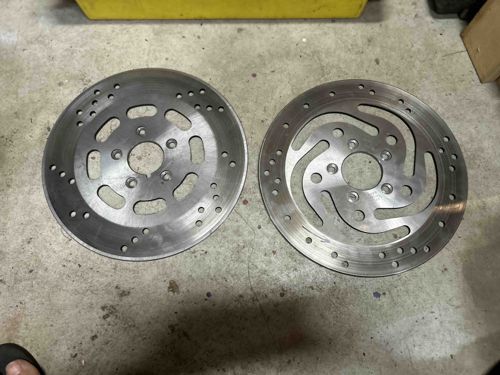
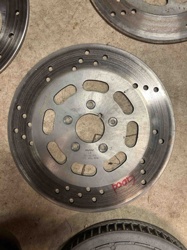
The image displays two motorcycle brake rotors, likely made from a metallic alloy such as stainless steel or cast iron, given their typical application and appearance. Both rotors feature a central hub area designed for attachment to a wheel, indicated by multiple bolt holes arranged in a circular pattern around a larger central bore. The surface is polished metal with visible concentric machining marks, indicative of their manufacturing process. Both rotors exhibit various perforations and slots which are characteristic designs to aid in heat dissipation, reduce weight, and prevent brake fade. The rotor on the left has elongated slots and circular holes distributed across its surface, while the rotor on the right features a more intricate, 'swirl' or 'wave' pattern of slots along with circular holes. This difference in design suggests they might be from different manufacturers or designed for different performance characteristics, or perhaps even a front and rear setup. The general condition appears used, with some surface wear, minor rust on the edges and in the bore, and possibly some heat discoloration, which is typical for used brake components. No specific manufacturer's marks or part numbers are discernible from the image. Esthetically, they appear to be standard, functional components rather than highly decorative items. The exact size is not provided, but they appear to be of a common motorcycle rotor diameter, likely in the range of 10-12 inches (250-300mm). The craftsmanship appears to be industrial standard, with no obvious flaws or signs of poor manufacturing.
AI Appraisal Report
Upon visual examination of the provided image, I assess these motorcycle brake rotors to be in used, fair condition. They exhibit common signs of wear for used brake components, including surface wear, minor rust on the edges and in the bore, and potential heat discoloration. The presence of machining marks indicates standard manufacturing processes. Authenticity, based solely on visual inspection of the image, appears to be that of genuine, functional motorcycle brake rotors, not replicas. However, without legible manufacturer marks or part numbers, precise identification of the original equipment manufacturer (OEM) or aftermarket brand is impossible.
Market conditions for used motorcycle brake rotors are generally steady. Comparables for generic used rotors vary widely based on material, brand, and specific motorcycle fitment. These appear to be common designs, suggesting a broad market. Demand for used rotors is moderate, typically sought by individuals looking for cost-effective replacements. Rarity is not a factor here; these are mass-produced items.
Factors significantly impacting value include the lack of identifiable brand, specific motorcycle application, and precise mileage/wear. The differing designs suggest they may not be a matching set from the same manufacturer or for the same motorcycle, which further diminishes individual value. Without a clear brand or fitment, their market is limited to generic replacement parts.
Limitations in authenticity verification from images alone are significant. I cannot confirm the exact material composition, true wear depth, flatness, or potential warping without physical inspection. For full authentication and accurate valuation, an in-person examination would be critical to check for runout, thickness, and precise fitment. Provenance documentation, such as service records or original purchase receipts, would greatly assist in verifying the item's history and original application. Scientific testing, like material analysis, would confirm the alloy composition.