AI estimate as of July 10, 2025 · verify with a professional before acting
AI-Generated · Verify before acting
Everything on this page is generated by AI for informational purposes only. AI can make mistakes — the AI may misidentify items or misattribute them (artist, maker, brand, designer, origin, era). This is not an official valuation and should not be used for insurance, sale, tax, estate, legal, or lending purposes — or any decision requiring a certified appraisal. It is not an authoritative claim about any person, brand, or rights holder — do not share or rely on it as a factual statement about a third party. Always consult qualified professionals before making financial decisions.
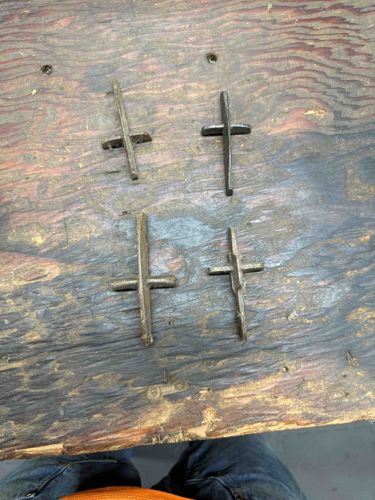
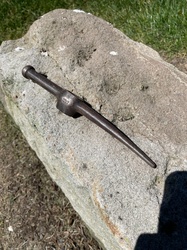
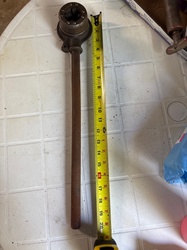
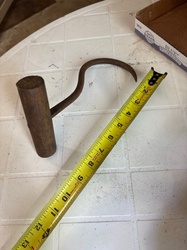
This lot consists of four vintage or antique woodworking marking gauges, specifically a type often referred to as 'mortise gauges' or 'cutting gauges,' given their cross-bar design. Each gauge features a long, slender wooden stem (or beam) with a cross-piece at one end. The cross-pieces appear to be fixed, suggesting they are used for marking a consistent, shallow depth or a single fixed line. Three of the four gauges appear to have their cross-pieces securely attached, while the top-left item's cross-piece seems to be slightly askew or has a different attachment method, possibly a wedge. The wood is dark, heavily patinated, and shows significant signs of age and considerable use, including nicks, dents, and surface wear consistent with being handled in a workshop environment. The color is a deep, aged brown to almost black, indicating either a naturally dark wood, a stain, or accumulation of grime over many years. The construction appears to be simple but robust, likely hand-carved or fashioned from hardwood. There are no visible maker's marks or distinguishing engravings, suggesting a common design or artisanal origin. The visible condition issues are primarily surface wear and a rich patina, which is desirable for antique tools as it reflects their history and authenticity. The tools likely date to the late 19th or early to mid-20th century, a period when such manual woodworking tools were indispensable. Their quality lies in their functional design and the durability of the materials, crafted for practical utility rather than elaborate aesthetics.
AI Appraisal Report
I have examined the provided image of the Set of Four Antique Woodworking Marking / Mortise Gauges. The condition appears to be very good for their age, exhibiting a desirable patina, nicks, and surface wear consistent with authentic period use rather than significant damage. The deep, aged brown color suggests either a naturally dark wood or years of workshop accumulation. The simple, robust construction aligns with hand-fashioned tools from the late 19th to mid-20th century. The slightly askew cross-piece on the top-left item is likely a variation in construction or a minor attachment shift, not necessarily a defect, adding to their artisanal character. Authenticity, based purely on visual examination, appears high; these are consistent with genuine antique woodworking tools. Without physical inspection, I cannot confirm wood type, precise construction methods (e.g., joinery), or detect subtle repairs or hidden damage. Verification of maker's marks, if any were obscured, would require in-hand examination. Provenance documentation could significantly enhance value but is absent. The market for antique woodworking tools is generally stable, driven by collectors, woodworkers, and historical enthusiasts. While not exceedingly rare, a complete set of four similar gauges in good, usable condition is desirable. Demand exists for functional and aesthetically pleasing tools that tell a historical story. Factors impacting value positively include their authentic patination and apparent completeness as a set. The lack of discernible maker's marks slightly limits top-tier collector value but does not diminish their appeal to users or general antique tool collectors. These are utilitarian objects whose value derives from their age, condition, and historical utility. Scientific testing would be excessive for items of this type, but a physical inspection would allow for a more thorough assessment of wood species, precise dating, and structural integrity.