AI estimate as of July 21, 2025 · verify with a professional before acting
AI-Generated · Verify before acting
Everything on this page is generated by AI for informational purposes only. AI can make mistakes — the AI may misidentify items or misattribute them (artist, maker, brand, designer, origin, era). This is not an official valuation and should not be used for insurance, sale, tax, estate, legal, or lending purposes — or any decision requiring a certified appraisal. It is not an authoritative claim about any person, brand, or rights holder — do not share or rely on it as a factual statement about a third party. Always consult qualified professionals before making financial decisions.
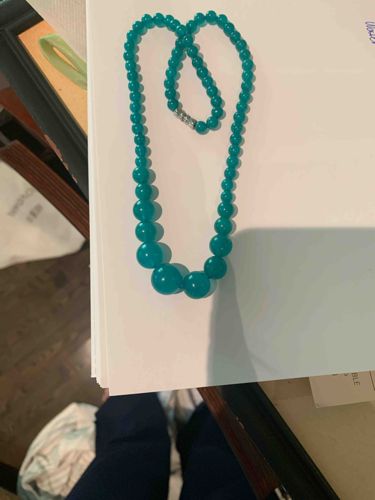
This is a graduated beaded necklace, exhibiting a vibrant teal or turquoise color, consistent with dyed chalcedony, dyed jade, or possibly a synthetic resin like bakelite or lucite, given the smooth, opaque appearance. The necklace features spherical beads that increase in size towards the center front, then decrease again towards the back closure. The smallest beads, located near the clasp, appear to be approximately 4-6mm in diameter, while the largest central beads could be 12-15mm. The beads are uniform in color and appear to be well-polished, suggesting a smooth, glossy finish. They are strung on a visible thread or cord, which appears to be white or light-colored, and there are no knots visible between the beads, which might indicate a continuous stringing or a more economical construction. The necklace is secured by a rectangular, possibly white metal (silver-tone) box clasp with a textured or ribbed surface, which might be a filigree or an engraved pattern. There are no obvious maker's marks or signatures visible on the clasp or beads from the provided image. The overall condition appears to be good with no obvious chips, cracks, or significant abrasions on the beads. The vivid color suggests it could be a costume jewelry piece from the mid-20th century, possibly 1940s-1970s, a period when such bold colors and graduated bead designs were popular. Without further inspection, the exact material cannot be definitively confirmed, which would significantly impact its value; however, the visual characteristics lean towards a non-precious material, likely a dyed stone or plastic, designed for fashionable wear. The craftsmanship appears to be standard for mass-produced jewelry of this style, focusing on the visual impact of the color and graduated design.
AI Appraisal Report
Upon visual examination of this graduated beaded necklace, I assess it to be a piece of costume jewelry, likely dating from the mid-20th century (c. 1940s-1970s). The beads are a vibrant, uniform teal color and exhibit a smooth, polished surface. They are graduated in size, ranging from approximately 4-6mm to 12-15mm at the center, and strung on a light-colored cord without knots between the beads. The clasp is a silver-tone rectangular box clasp with a textured surface. The condition appears to be very good, with no visible chips or significant wear.
The primary factor impacting value is the material. Based on the visual characteristics—the intense, even color and opaque, glossy finish—the beads are most likely a dyed stone like chalcedony or an early plastic such as bakelite or lucite, rather than natural, untreated turquoise or jade. The construction is consistent with mass-produced fashion jewelry of its era.
The market for vintage costume jewelry of this style is fairly active, but values are modest unless attributed to a specific high-end designer. Rarity is low, as similar necklaces were produced in large quantities. A definitive appraisal would require in-person examination to test the material (e.g., thermal or chemical tests for bakelite, gemological testing for stone identification) and inspect the clasp for any maker's marks not visible in the image. Without this physical verification, my appraisal is based on the assumption that it is a well-preserved, but non-precious, vintage costume piece.