AI Appraisal Estimate

AI-generated estimates · not official valuations

From the user

What was submitted

Photo and notes provided by the user — not generated by AI

Submitted item photo
Submitted photo · May 17, 2026

User's notes

No additional notes provided.

AI analysis below

AI appraisal

AI analysis & estimate

AI-Generated · Verify before acting

Everything below is generated by AI for informational purposes only. AI can make mistakes — the AI may misidentify items or misattribute them (artist, maker, brand, designer, origin, era). This is not an official valuation and should not be used for insurance, sale, tax, estate, legal, or lending purposes — or any decision requiring a certified appraisal. It is not an authoritative claim about any person, brand, or rights holder — do not share or rely on it as a factual statement about a third party. Always consult qualified professionals before making financial decisions.

Read the full disclaimer

AI Identification

·Not independently authenticated·Verify before acting

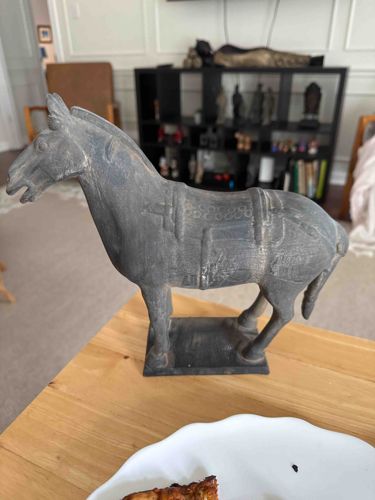
Tang Dynasty Style Ceramic Caparisoned Horse

Asian Antiques & Decorative Arts

AI Estimated Value

·Not an official valuation·Verify before acting

$100 - $250

As of May 17, 2026

AI Item Analysis

·AI can make mistakes·Verify before acting
This is a ceramic funerary sculpture of a standing horse, designed in the classic style of the Chinese Tang Dynasty (618–907 AD), though likely a mid-20th-century or modern reproduction for the decorative market. The figure is constructed from a dark gray earthenware or terracotta, featuring a matte, weathered finish that mimics 'unglazed' burial pottery. It stands atop a rectangular integrated plinth for stability. The horse is depicted with an open mouth, alert ears, and a docked tail. Notable features include a detailed saddle and caparison (harnessing) decorated with incised geometric patterns and circular motifs. The surface displays significant artificial 'patina,' which includes calcified white deposits and superficial abrasions intended to simulate centuries of burial in soil. The craftsmanship shows stylized anatomical proportions typical of ancient Chinese art, emphasizing a strong neck and sturdy legs. While it lacks visible maker's marks, the uniform wear and the specific carving style of the harness suggest it is a high-quality decorative piece. Condition appears stable with no major structural cracks visible, although the deliberate surface distressing makes it difficult to distinguish between intentional 'antiquing' and minor modern chips.
AI Appraisal Report

·AI can make mistakes·Verify before acting
Based on my visual examination of this ceramic horse, it presents as a decorative reproduction in the style of Tang Dynasty (618–907 AD) burial pottery (mingqi), likely produced in the mid-to-late 20th century. The piece is modeled from dark gray earthenware with an intentionally distressed matte finish. While the anatomical modeling—specifically the arched neck and open mouth—captures the spirit of Tang statuary, the surface treatment reveals its modern origins. The white deposits, intended to mimic the calcification and soil accretion found on genuine excavated artifacts, appear superficial and uniform, lacking the organic, inconsistent adhesion of true burial encrustation. Additionally, the incised detailing on the saddle and trappings is somewhat sharp and uniform, indicative of modern tooling rather than ancient hand-modeling techniques. The current market is saturated with similar high-quality 'decorator' reproductions, often imported during the 1980s and 90s. While genuine Tang Dynasty horses command prices in the tens of thousands to hundreds of thousands, decorative examples like this are valued strictly for their aesthetic appeal in interior design. Demand for these specific gray pottery reproductions has softened compared to the vibrant 'sancai' glazed style reproductions. It is crucial to note that definitive authentication of ancient Chinese pottery cannot be achieved through photographs alone. To determine if this were a genuine antiquity (which would drastically increase the value), I would require thermoluminescence (TL) testing to date the firing of the clay, as well as an in-person inspection of the interior cavity and soil deposits under magnification. Without such scientific evidence, or concrete provenance dating back prior to modern import restrictions, this piece must be appraised as a vintage decorative reproduction.

Get your items appraised

Instant estimates of your treasures with AI-powered appraisals

Browse More Appraisals