AI Appraisal Estimate

AI-generated estimates · not official valuations

From the user

What was submitted

Photo and notes provided by the user — not generated by AI

Submitted item photo
Submitted photo · June 8, 2026

User's notes

No additional notes provided.

AI analysis below

AI appraisal

AI analysis & estimate

AI-Generated · Verify before acting

Everything below is generated by AI for informational purposes only. AI can make mistakes — the AI may misidentify items or misattribute them (artist, maker, brand, designer, origin, era). This is not an official valuation and should not be used for insurance, sale, tax, estate, legal, or lending purposes — or any decision requiring a certified appraisal. It is not an authoritative claim about any person, brand, or rights holder — do not share or rely on it as a factual statement about a third party. Always consult qualified professionals before making financial decisions.

Read the full disclaimer

AI Identification

·Not independently authenticated·Verify before acting

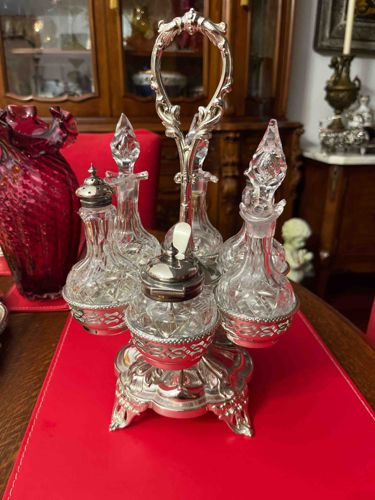
Victorian Style Silver-Plated and Cut Glass Cruet Set

Antique Silver & Tableware

AI Estimated Value

·Not an official valuation·Verify before acting

$225 - $375

As of June 8, 2026

AI Item Analysis

·AI can make mistakes·Verify before acting
This is a late 19th to early 20th-century Victorian-style cruet set, designed for table service of condiments. The set features a highly ornate silver-plated revolving frame supported by four stylized acanthus leaf feet. The central stalk culminates in a large, decorative oval finger loop handle embellished with scrolls and foliate motifs. The frame holds five individual clear cut-glass bottles and jars, nestled within openwork silver-plated galleries that feature a repetitive pierced lattice pattern. The glassware includes three cruets with pointed faceted stoppers, likely for oil and vinegar, and two jars with silver-plated tops: one featuring a perforated shaker lid for salt or pepper and another with a hinged lid and a small notch for a mustard spoon (spoon visible). The glass is intricately cut with a diamond pattern on the lower bulbous portion, which transitions into vertical fluting on the necks. Physically, the silver plating appears bright and well-polished, though minor areas of tarnishing and possible copper-bleed are visible around the base and handles, typical of age and frequent cleaning. The glass components appear in good antique condition, with no immediate signs of large chips or cracks, although many of these sets often exhibit minor fleabites on the stopper bases. The overall craftsmanship suggests a high-quality production for middle-class dining, likely of British or American manufacture during the late Victorian era. Such sets were staples of formal dining etiquette and are valued for their decorative presence as much as their functional history.
AI Appraisal Report

·AI can make mistakes·Verify before acting
This late 19th-century Victorian-style revolving cruet set presents in excellent aesthetic condition. My examination of the silver-plated frame reveals high-quality craftsmanship, particularly in the pierced lattice galleries and the ornate foliate handle. The presence of 'copper-bleed' on high points confirms the piece is silver-on-copper electroplate, consistent with the era. The clear cut-glass bottles appear original and benefit from a complete set of matching faceted stoppers and silver-topped lids, which significantly bolsters the value. Market demand for silver-plated hollowware has softened compared to sterling, yet complete sets with original glass remain desirable among Victorian era collectors and interior decorators. Comparable auction results for five-bottle sets in this condition typically fall within the $200 to $400 range. Key value drivers here are the revolving mechanism's functionality and the 'completeness' of the set, as replacing missing mustard spoons or matching ground-glass stoppers is difficult and costly. One limiting factor is the lack of visible hallmarks or maker's marks, which might identify a prestigious manufacturer like Elkington or Meriden. This appraisal is based strictly on photographic evidence. A formal physical inspection is required to check for 'fleabite' chips at the bottle bases and to verify the structural integrity of the central stalk. Scientific testing (XRF) could confirm the base metal composition, and provenance documentation would be necessary to elevate the set’s value by linking it to a specific historical household or noted manufacturer.

Get your items appraised

Instant estimates of your treasures with AI-powered appraisals

Browse More Appraisals