AI estimate as of November 26, 2025 · verify with a professional before acting
AI-Generated · Verify before acting
Everything on this page is generated by AI for informational purposes only. AI can make mistakes — the AI may misidentify items or misattribute them (artist, maker, brand, designer, origin, era). This is not an official valuation and should not be used for insurance, sale, tax, estate, legal, or lending purposes — or any decision requiring a certified appraisal. It is not an authoritative claim about any person, brand, or rights holder — do not share or rely on it as a factual statement about a third party. Always consult qualified professionals before making financial decisions.
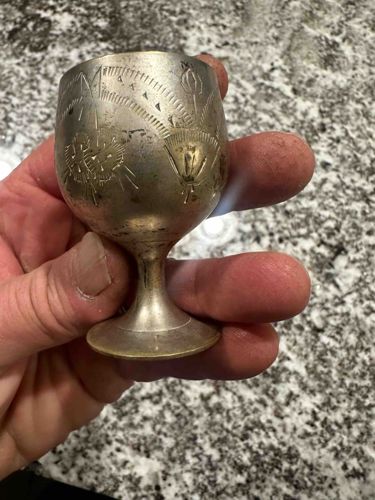
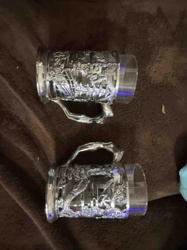
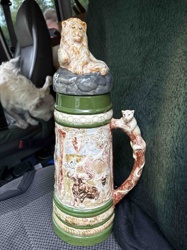
This item is a small, goblet-shaped vessel, likely intended as a shot glass or perhaps a decorative miniature chalice. It appears to be constructed from a non-ferrous metal, possibly silver-plated brass, pewter, or a similar alloy, given its tarnished, silvery-grey color with hints of a warmer undertone where the plating might have worn thin, especially near the base. The overall height appears to be approximately 2-3 inches, judging by its scale in the hand holding it. The bowl of the goblet is adorned with intricate, hand-engraved patterns. These patterns include multiple linear designs, possibly representing abstract flora or geometric motifs, such as a fan-like structure near the bottom of the bowl and what could be stylized leaves or buds at the rim. There are also dotted or dashed line patterns creating textured areas. The engraving style suggests a folk art or artisanal origin rather than mass production. The surface exhibits significant wear, including scratches, nicks, and a heavy, uneven patina which obscures some of the finer details of the engraving and metal composition. There are no visible maker's marks or signatures in the provided image. The construction appears to be a single piece, with the bowl seamlessly flowing into a short, tapered stem that widens to a flat, circular base. The craftsmanship, while showing skill in engraving, also indicates some irregularities consistent with handmade items. The heavy patina suggests considerable age, potentially late 19th to early 20th century, or it could be a newer piece designed to emulate an antique style. The unique hand-engraved designs are its most distinguishing feature, making each piece potentially one-of-a-kind.
AI Appraisal Report
Based on my visual examination of the provided image, this engraved metal goblet/shot glass exhibits characteristics consistent with a handmade, possibly folk art, piece. Its condition shows significant wear, including scratches, nicks, and a heavy, uneven patina, which I interpret as age-appropriate for an older item or deliberate antiquing for a newer piece. The intricate, hand-engraved patterns are the primary artistic feature, suggesting an artisan's touch rather than mass production. The lack of visible maker's marks or signatures, however, makes definitive attribution challenging. I assess its authenticity as likely a genuine older handcrafted item, but without physical inspection, I cannot rule out a more modern replica designed to appear antique.
In terms of market conditions, similar small, anonymous metal decorative drinkware pieces with folk art engraving typically appeal to collectors of unusual or handcrafted items. Comparables would include unhallmarked pewter, brass, or silver-plated novelties, though the individual engraving style makes direct comparison difficult. Demand for such items is generally niche, driven more by aesthetic appeal and perceived age than by intrinsic material value or provenance. Rarity is moderate; while the specific engraving is unique, the form factor is not uncommon.
Factors significantly impacting value are the distinctiveness and quality of the engraving, the presumed age (which contributes to its character), and the unknown metal composition. Without physical examination, I cannot confirm the metal type (e.g., silver plate vs. base metal), which affects intrinsic value. For full authentication, an in-person examination would be crucial to assess the material properties, confirm manufacturing techniques (e.g., hand-engraving vs. machine), and search for any hidden marks. Provenance documentation could significantly enhance value, and scientific testing (e.g., XRF analysis for metal composition) would definitively determine the material. Limitations in verifying authenticity and exact age solely from images mean this appraisal is based on visual cues and market tendencies for similar decorative objects.