AI Appraisal Estimate

AI-generated estimates · not official valuations

From the user

What was submitted

Photo and notes provided by the user — not generated by AI

Submitted item photo
Submitted photo · May 25, 2026

User's notes

No additional notes provided.

AI analysis below

AI appraisal

AI analysis & estimate

AI-Generated · Verify before acting

Everything below is generated by AI for informational purposes only. AI can make mistakes — the AI may misidentify items or misattribute them (artist, maker, brand, designer, origin, era). This is not an official valuation and should not be used for insurance, sale, tax, estate, legal, or lending purposes — or any decision requiring a certified appraisal. It is not an authoritative claim about any person, brand, or rights holder — do not share or rely on it as a factual statement about a third party. Always consult qualified professionals before making financial decisions.

Read the full disclaimer

AI Identification

·Not independently authenticated·Verify before acting

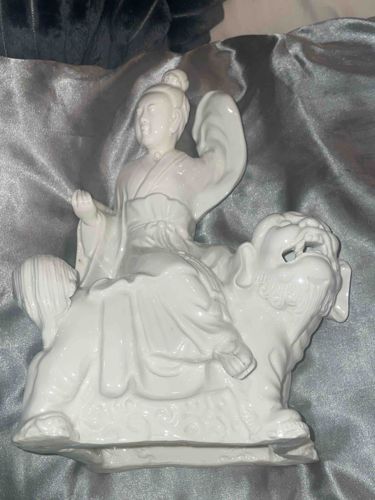
Dehua Blanc de Chine Figure of Guanyin Riding a Qilin

Asian Antiques and Collectibles - Porcelain

AI Estimated Value

·Not an official valuation·Verify before acting

$150 - $250

As of May 25, 2026

AI Item Analysis

·AI can make mistakes·Verify before acting
This is a white porcelain figurine, specifically in the Dehua 'Blanc de Chine' style, depicting a female deity—likely Guanyin—seated atop a mythical Qilin beast. The figure is characterized by a creamy, monolithic white glaze that covers the entire ceramic body. The female figure is dressed in flowing traditional robes with intricate folds and her hair is styled in a high top-knot bun. The mythical Qilin features a wide, expressive face with an open mouth, curled mane, and a feathered tail, classic to Chinese mythological depictions. The base of the sculpture shows decorative scrolling clouds or waves, suggesting a divine or celestial realm. The craftsmanship highlights detailed molding in the facial features and the texture of the beast. In terms of condition, there is a visible chip or breakage on the lower front right corner of the base, and some surface grime or dust is present in the crevices of the glaze. This style of porcelain originated in the Fujian province and reached its peak popularity during the Ming and Qing dynasties; however, this specific piece appears to be a 20th-century decorative export-ware reproduction based on the sharpness of the molding and glaze consistency. There are no maker's marks visible on the front, though such pieces often have impressed gourde shaped stamps on the reverse.

AI Appraisal Report

·AI can make mistakes·Verify before acting
I have examined the provided description and visual characteristics of this Dehua 'Blanc de Chine' figure depicting Guanyin on a Qilin. My assessment identifies this piece as a 20th-century decorative export-ware reproduction rather than a period piece from the Ming or Qing dynasties. The creamy glaze is consistent with mid-to-late 20th-century Fujian production, though the sharpness of the molding and the uniformity of the glaze thickness lack the subtle 'mutton fat' depth seen in earlier examples. The condition is compromised by a significant visible chip on the lower front right corner of the base, which notably detracts from its collector value. While the subject matter remains popular, the market for 20th-century reproductions is stable but relatively low-value, with similar pieces frequently appearing at regional auctions. The absence of marks on the front is typical; however, the potential presence of an impressed He Chaozong or similar shop mark on the reverse would likely be apocryphal given the technical execution. The primary value drivers here are decorative appeal and size. Please note that this appraisal is limited by the lack of physical inspection. A definitive authentication would require a hands-on examination to check for 'kiln grit' on the unglazed footrim, a microscopic review of glaze bubbles (longyan), and potentially a thermoluminescence (TL) test to confirm the firing date. Provenance documentation, such as an original bill of sale from a reputable mid-century export firm, would also be necessary to refine this valuation. Given the current damage and production era, the value reflects its status as a high-quality decorative object rather than a fine antique.

Get your items appraised

Instant estimates of your treasures with AI-powered appraisals

Browse More Appraisals