Late Victorian Weatherby Hanley 'Falcon Ware' Ceramic Piece
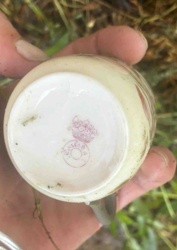
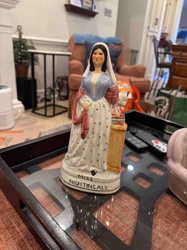
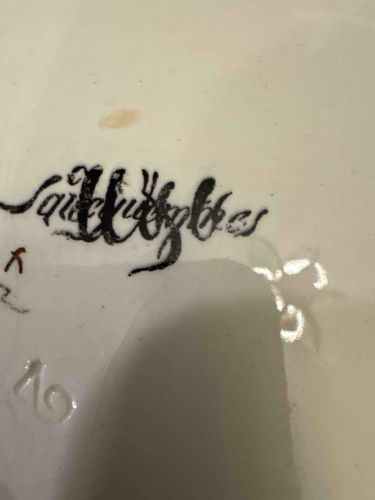
This item is an antique ceramic object, likely a plate or serving platter, identified by the distinctive backstamp of Weatherby Hanley. The mark features an overlapping decorative script 'W' and 'B' (Weatherby Brothers), which was a common pottery mark for the firm located at the Falcon Pottery in Hanley, Stoke-on-Trent, England. The construction is typical of English earthenware or ironstone from the late 19th to early 20th century. The glaze is a creamy white, showing signs of aged character including subtle crazing and several scattered brown oxidation spots (foxing), which are characteristic of porous earthenware being exposed to moisture over decades. A notable manufacturing detail is the incised numerical mark '10' or '19' and a small hand-painted iron-red 'x' or cross-mark, likely a decorator's or gilder's mark used for internal quality control or piece-rate tracking. The black transfer-printed logo shows some blurring, a common occurrence during the firing process of that era. There are visible surface scratches and minor pitting in the glaze, suggesting regular historical use. Overall, the piece displays quality representative of mass-produced English pottery from the late Victorian to Early Edwardian period (circa 1891-1920).

AI-Generated Appraisal Disclaimer
Estimated Value
$25.00-$45.00
Basic Information
Category
Antique Ceramics & Pottery
Appraised On
March 18, 2026
Estimated Value
$25.00-$45.00
Item Description
This item is an antique ceramic object, likely a plate or serving platter, identified by the distinctive backstamp of Weatherby Hanley. The mark features an overlapping decorative script 'W' and 'B' (Weatherby Brothers), which was a common pottery mark for the firm located at the Falcon Pottery in Hanley, Stoke-on-Trent, England. The construction is typical of English earthenware or ironstone from the late 19th to early 20th century. The glaze is a creamy white, showing signs of aged character including subtle crazing and several scattered brown oxidation spots (foxing), which are characteristic of porous earthenware being exposed to moisture over decades. A notable manufacturing detail is the incised numerical mark '10' or '19' and a small hand-painted iron-red 'x' or cross-mark, likely a decorator's or gilder's mark used for internal quality control or piece-rate tracking. The black transfer-printed logo shows some blurring, a common occurrence during the firing process of that era. There are visible surface scratches and minor pitting in the glaze, suggesting regular historical use. Overall, the piece displays quality representative of mass-produced English pottery from the late Victorian to Early Edwardian period (circa 1891-1920).

Related Tags
Get Your Items Appraised
Instant estimates of your treasures with AI-powered instant appraisals