AI estimate as of September 16, 2025 · verify with a professional before acting
AI-Generated · Verify before acting
Everything on this page is generated by AI for informational purposes only. AI can make mistakes — the AI may misidentify items or misattribute them (artist, maker, brand, designer, origin, era). This is not an official valuation and should not be used for insurance, sale, tax, estate, legal, or lending purposes — or any decision requiring a certified appraisal. It is not an authoritative claim about any person, brand, or rights holder — do not share or rely on it as a factual statement about a third party. Always consult qualified professionals before making financial decisions.
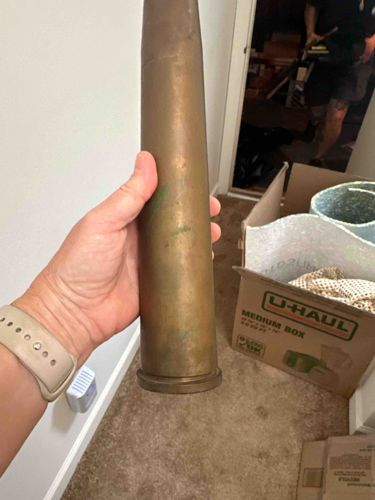
The item depicted is a large, spent artillery shell casing, likely made of brass due to its characteristic golden-brown metallic color and visible patina. It is cylindrical in form, tapering slightly towards the top (which is not fully visible, suggesting a possibly open or cut end). The base, which is clearly visible and held by a hand, features a distinct primer indentation and a reinforced rim, typical of ammunition casings. The overall length of the casing appears significant, perhaps 18-24 inches, judging by its proportion to the human hand holding it. The surface exhibits a visible patina, indicating age and exposure, with areas of darker discoloration and green oxidation, particularly along the body. There are no visible maker's marks or caliber stamps discernible from the image, which would typically be found on the base or rim. The metal surface shows mild scuffs and scratches consistent with handling and age, but no major dents or structural damage are obvious. This piece likely dates from the early to mid-20th century, possibly from World War I or World War II, given the prevalent use of such brass casings during those periods. Its construction appears robust and uniform, characteristic of military-grade manufacturing. These casings are commonly repurposed as decorative items, such as umbrella stands or planters, due to their unique form and historical significance. The quality of craftsmanship, while utilitarian, reflects the precision required for ammunition manufacturing.
AI Appraisal Report
I have examined the image of this spent artillery shell casing. Visually, the item appears to be an authentic brass casing, consistent with early to mid-20th century military production. The golden-brown metallic color, visible patina, distinct primer indentation on the base, and reinforced rim all support this assessment. Its size, estimated at 18-24 inches, suggests it might be from a common field artillery piece, possibly 75mm or 105mm, from WWI or WWII. The condition is good, exhibiting age and handling via discoloration, mild green oxidation, scuffs, and scratches, but no major damage. This wear is expected for a military collectible of this type and age.
Market conditions for spent artillery casings are generally stable. These items are fairly common, especially from the World Wars, and are often collected for decorative purposes or by military history enthusiasts. Comparables on online auction sites and militaria dealers suggest values ranging from $50 to $150 for similar condition and size. The lack of discernible maker's marks or caliber stamps, which are crucial for specific identification and can significantly impact value for collectors, limits its top-end potential. Rarity is moderate; while not unique, this size and condition maintain a steady demand.
Factors impacting value include its good overall condition, apparent authenticity, and decorative appeal. However, the absence of clear identifying marks (caliber, manufacturer, date) prevents a higher valuation. Without an in-person examination, I cannot definitively confirm the metal composition, precise dimensions, or the presence of any hidden damage or repairs. Full authentication would benefit from physical inspection to verify markings and material, and provenance documentation (e.g., where it was found or its history) would add significantly to its desirability and value.