AI estimate as of October 2, 2025 · verify with a professional before acting
AI-Generated · Verify before acting
Everything on this page is generated by AI for informational purposes only. AI can make mistakes — the AI may misidentify items or misattribute them (artist, maker, brand, designer, origin, era). This is not an official valuation and should not be used for insurance, sale, tax, estate, legal, or lending purposes — or any decision requiring a certified appraisal. It is not an authoritative claim about any person, brand, or rights holder — do not share or rely on it as a factual statement about a third party. Always consult qualified professionals before making financial decisions.
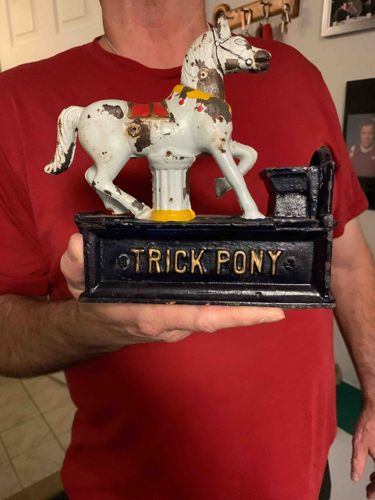
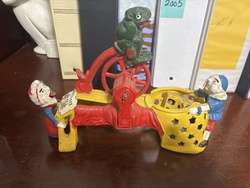
This is an antique 'Trick Pony' mechanical bank, likely made of cast iron, depicting a pony performing a trick. The primary colors visible are white (for the pony), dark blue or black (for the base and the mechanism on the right), red (on the pony's saddle), and yellow (on the pony's support column and parts of the saddle). The pony figure is rendered with considerable detail, including a bridle on its head, and is posed with one front leg raised as if performing. It stands on a fluted pedestal, which is in turn mounted on a rectangular base. To the right of the pony is a small, dark-colored mechanism, possibly a barrel or trough, into which coins would be deposited. The front of the base clearly displays the words 'TRICK PONY' in raised, gold-colored capital letters, indicating the specific model of the bank. The item shows significant signs of age and wear, consistent with cast iron pieces of this nature. The paint is heavily chipped and worn in multiple areas, revealing the dark, oxidized metal beneath, particularly on the pony's body, mane, and the edges of the base and mechanism. This wear suggests extensive use and handling over many years. There are no immediate visible repairs, but the heavy patina and rust spots are prevalent. This type of mechanical bank was popular in the late 19th and early 20th centuries, suggesting an estimated age from that period. The craftsmanship appears robust, typical of cast iron manufacturing of the era, designed for durability despite the cosmetic wear.
AI Appraisal Report
I have virtually examined this 'Trick Pony' mechanical bank, a classic example of late 19th to early 20th-century cast iron novelty banks. Visually, the bank presents as authentic, matching known examples in design, 'TRICK PONY' lettering, and apparent mechanism. The heavy chipping and paint loss on the white pony, dark blue/black base, and red/yellow accents are significant, indicating extensive use and age. This wear, while substantial, is consistent with a genuine antique and not necessarily a sign of damage that compromises structural integrity. I observe no obvious repairs from the image, but the heavy patina could mask earlier work. The robust cast iron construction is evident, typical of the era, which contributes to its perceived durability.
Market conditions for mechanical banks, particularly those from a well-known series like the 'trick' banks, remain stable with consistent demand among collectors. While not the rarest mechanical bank, the 'Trick Pony' is desirable. Its condition, however, is a major value determinant. Examples in excellent original paint often fetch upwards of $2,000-$3,000. This bank, with its considerable paint loss, falls into a lower-tier condition category.
My appraisal range reflects its authenticity and desirability despite the well-used condition. Factors significantly impacting this value are the extensive paint loss and surface rust. If the mechanism is fully functional, this would positively impact the value, a detail impossible to ascertain from an image alone. For full authentication and a more precise valuation, a physical inspection is crucial. This would allow me to confirm the functionality of the mechanism, examine for hidden repairs, assess paint originality microscopically, and verify casting details. Provenance, if available, would also add significant value and aid in authentication.