Japanese Lusterware Porcelain Teapot with Poppy Motif
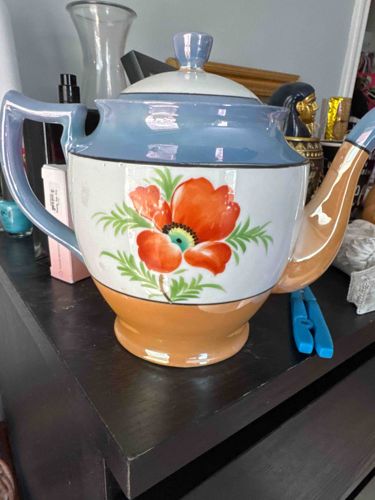
This is a vintage Japanese lusterware porcelain teapot, characteristic of the Art Deco period, likely dating from the 1920s to the 1940s. The piece features a globular body with a pedestal base and a tiered lid topped with a matching knob finial. The exterior is decorated with three distinct horizontal color bands: a periwinkle blue luster finish on the upper shoulder and lid, a central white band featuring a large hand-painted orange poppy with green foliage, and a warm peach-gold luster finish on the lower body and spout. The spout is uniquely bifurcated in color, transitioning from peach to blue. Each color section is separated by a fine, dark pinstripe border, showing precise application. The handle is arched and finished in the blue luster glaze. The condition appears fair to good with visible surface wear; there are small dark carbon spots (kiln debris) characteristic of early 20th-century Japanese ceramic production, and minor abrasions to the luster finish, particularly around the spout and handle. This style is often associated with manufacturers like Noritake or generic 'Hand Painted Made in Japan' imports of the era, showcasing the popular iridescent glazes that define lusterware of this period.
AI-Generated Appraisal Disclaimer
Estimated Value
$45.00 - $65.00
Basic Information
Category
Antique/Vintage Ceramics and Teaware
Appraised On
January 21, 2026
Estimated Value
$45.00 - $65.00
Item Description
This is a vintage Japanese lusterware porcelain teapot, characteristic of the Art Deco period, likely dating from the 1920s to the 1940s. The piece features a globular body with a pedestal base and a tiered lid topped with a matching knob finial. The exterior is decorated with three distinct horizontal color bands: a periwinkle blue luster finish on the upper shoulder and lid, a central white band featuring a large hand-painted orange poppy with green foliage, and a warm peach-gold luster finish on the lower body and spout. The spout is uniquely bifurcated in color, transitioning from peach to blue. Each color section is separated by a fine, dark pinstripe border, showing precise application. The handle is arched and finished in the blue luster glaze. The condition appears fair to good with visible surface wear; there are small dark carbon spots (kiln debris) characteristic of early 20th-century Japanese ceramic production, and minor abrasions to the luster finish, particularly around the spout and handle. This style is often associated with manufacturers like Noritake or generic 'Hand Painted Made in Japan' imports of the era, showcasing the popular iridescent glazes that define lusterware of this period.
Get Your Items Appraised
Instant estimates of your treasures with AI-powered instant appraisals