Pair of Polished Bovine Longhorns
Natural History / Western Americana Decor

Pair of Polished Bovine Longhorns

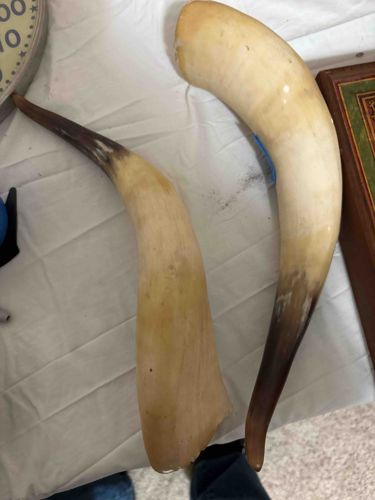
This item consists of a pair of large, polished animal horns, likely sourced from a bovine species such as Longhorn cattle or similar steer. The horns exhibit a distinct natural curvature and taper from a wide, hollow base to a slender, pointed tip. Their coloration is characteristic of organic keratin, featuring a creamy off-white or yellowish base that transitions into a deep brownish-black near the terminals. The surface shows evidence of mechanical polishing to achieve a smooth, semi-glossy finish, although natural grain lines, ridges, and striations remain visible throughout the structure. One horn appears slightly thicker and more curved than the other, suggesting they are a non-matched pair or from a different animal. Notable condition issues include minor surface scuffing, tiny pockmarks, and irregular edges at the base where they were detached from the skull. There are no visible maker's marks or decorative scrimshaw carvings, indicating they were prepared for raw display or as components for taxidermy mounts. Based on their style and preservation, they likely date from the mid-to-late 20th century, representing traditional Western or rustic decorative art. The craftsmanship is utilitarian, focused on preserving the natural integrity and dramatic sweep of the horns.
Estimated Value

$40 - $80

Basic Information

Category

Natural History / Western Americana Decor

Appraised On

December 20, 2025

Estimated Value

$40 - $80

Item Description

This item consists of a pair of large, polished animal horns, likely sourced from a bovine species such as Longhorn cattle or similar steer. The horns exhibit a distinct natural curvature and taper from a wide, hollow base to a slender, pointed tip. Their coloration is characteristic of organic keratin, featuring a creamy off-white or yellowish base that transitions into a deep brownish-black near the terminals. The surface shows evidence of mechanical polishing to achieve a smooth, semi-glossy finish, although natural grain lines, ridges, and striations remain visible throughout the structure. One horn appears slightly thicker and more curved than the other, suggesting they are a non-matched pair or from a different animal. Notable condition issues include minor surface scuffing, tiny pockmarks, and irregular edges at the base where they were detached from the skull. There are no visible maker's marks or decorative scrimshaw carvings, indicating they were prepared for raw display or as components for taxidermy mounts. Based on their style and preservation, they likely date from the mid-to-late 20th century, representing traditional Western or rustic decorative art. The craftsmanship is utilitarian, focused on preserving the natural integrity and dramatic sweep of the horns.
Get Your Items Appraised

Instant estimates of your treasures with AI-powered instant appraisals

Browse More Appraisals