AI estimate as of July 10, 2025 · verify with a professional before acting
AI-Generated · Verify before acting
Everything on this page is generated by AI for informational purposes only. AI can make mistakes — the AI may misidentify items or misattribute them (artist, maker, brand, designer, origin, era). This is not an official valuation and should not be used for insurance, sale, tax, estate, legal, or lending purposes — or any decision requiring a certified appraisal. It is not an authoritative claim about any person, brand, or rights holder — do not share or rely on it as a factual statement about a third party. Always consult qualified professionals before making financial decisions.
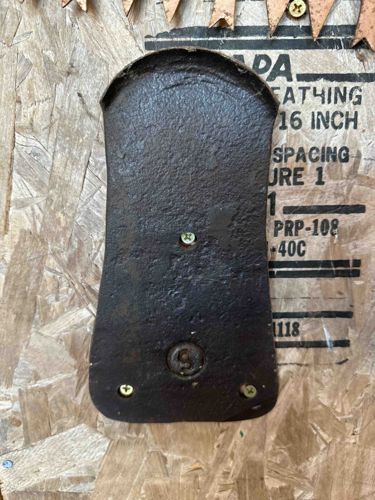
The item appears to be an antique or vintage cast iron roof finial, specifically the base or a decorative element meant to be mounted vertically. It is constructed from heavy cast iron, evident from its rough, textured black surface and substantial appearance. The finial is shaped somewhat like a shield or an elongated spade, with a rounded top and tapering sides that flare slightly towards a broader, flatter base. Its overall color is a dark, matte black, likely from either original paint or a long-developed patina of rust and dirt. There are visible signs of aging and wear, including surface pitting and irregularities characteristic of cast iron that has been exposed to the elements. Three prominent brass-colored Phillips head screws are visible, indicating it has been mounted on the wooden substrate, which appears to be OSB (Oriented Strand Board). These screws are clearly modern and not original to the piece, suggesting it has been repurposed or reinstalled. A notable feature is a circular indentation or raised boss near the bottom center of the item, which appears to contain a faint, possibly embossed or incised, mark that resembles the number “G.” or perhaps a stylized symbol. This mark could be a manufacturer's identification or a pattern number. The edges of the finial are thick and somewhat uneven, which is typical of cast iron manufacturing of earlier periods. There are no obvious signs of recent damage or repairs beyond the natural wear and tear. The craftsmanship suggests industrial-era production, likely late 19th to early 20th century, given the material and casting technique. Its quality is robust and functional, designed for durability outdoors, and the rustic patina adds to its antique appeal.
AI Appraisal Report
Based on my visual examination of the image provided, this appears to be an antique cast iron roof finial base, likely dating from the late 19th to early 20th century. Its robust construction and characteristic surface texture are consistent with period cast iron manufacturing for outdoor architectural use. The matte black finish and surface pitting suggest a well-developed patina from exposure to elements, which enhances its antique appeal. The 'G.' or stylized mark near the base is intriguing; an in-person examination, perhaps involving careful cleaning, would be necessary to identify if it's a manufacturer's mark, pattern number, or something else entirely.
Its condition is good, showing expected wear for its age and outdoor purpose, with no apparent significant damage or repairs beyond minor surface irregularities common to casting. The modern Phillips head screws and OSB substrate confirm its current mounting is a repurposing, which is typical for architectural salvage. This doesn't detract from the finial's intrinsic value as an antique piece of ironwork.
In terms of market conditions, architectural salvage, especially decorative cast iron, maintains a steady demand among restorers, decorators, and collectors. Its rarity is moderate; while not unique, similar pieces are not found in abundance. The demand for authentic period pieces for gardens, historical renovations, or unique interior design elements is consistent. Factors that significantly impact its value include its age, material authenticity, design aesthetic (which is pleasingly simplistic yet strong), and its condition. The "G." mark could potentially increase value if it identifies a specific, desirable foundry, but this cannot be confirmed without physical inspection.
My primary limitation in this appraisal is the lack of physical examination. I cannot verify the exact metal composition, confirm whether the black finish is original paint or a later application over old rust, or definitively identify the embossed mark. A physical inspection would allow for tactile assessment, detailed measurement, and potentially non-invasive metallurgical analysis if warranted, all of which would contribute to a more precise valuation and authenticity verification.