AI estimate as of November 30, 2025 · verify with a professional before acting
AI-Generated · Verify before acting
Everything on this page is generated by AI for informational purposes only. AI can make mistakes — the AI may misidentify items or misattribute them (artist, maker, brand, designer, origin, era). This is not an official valuation and should not be used for insurance, sale, tax, estate, legal, or lending purposes — or any decision requiring a certified appraisal. It is not an authoritative claim about any person, brand, or rights holder — do not share or rely on it as a factual statement about a third party. Always consult qualified professionals before making financial decisions.
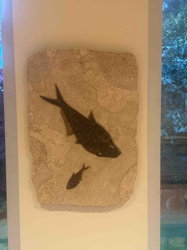
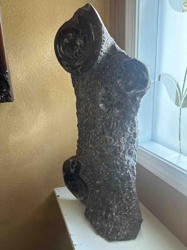
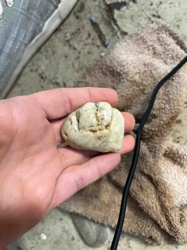
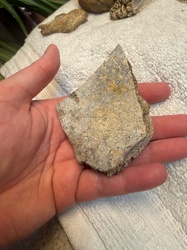
This item is a fossil plate, likely a slab of matrix rock, heavily embedded with numerous Orthoceras fossils. The overall shape of the plate is irregular and organic, suggesting it was cut or broken from a larger rock formation. The primary material is a dark grey to black sedimentary rock, possibly limestone or shale, which serves as the matrix for the fossils. The Orthoceras fossils themselves are distinct, elongated, conical shells, appearing in shades of darker grey to black, contrasting with the lighter, speckled or granular texture of the surrounding matrix. They are oriented in various directions, with many appearing roughly parallel or slightly fanned out, while some individual specimens are positioned perpendicularly or diagonally to the main cluster. A particularly prominent fossil is visible towards the left-center, notably larger and more intact than many others, showcasing its characteristic fusiform or cigar-like shape. The surface of the fossil plate is uneven, with the fossils raised slightly above the matrix, indicating they have been prepared to stand out in relief. The condition appears to be relatively good, with the fossils generally well-preserved and clearly distinguishable. There are no obvious signs of significant damage, repairs, or heavy wear from the visible portions. The granular texture of the matrix suggests a natural surface, possibly enhanced by polishing or cleaning to highlight the fossils. This piece is a natural geological specimen, showcasing ancient marine life. The density and arrangement of the fossils within the matrix suggest a 'death assemblage' – a common occurrence in fossil beds where many organisms were deposited together. The craftsmanship, in this case, refers to the careful preparation of the fossil plate to expose and preserve the Orthoceras specimens, characteristic of geological display pieces and collectible fossils. The estimated age of Orthoceras fossils typically ranges from the Ordovician to the Devonian periods, placing this item's origins hundreds of millions of years ago.
AI Appraisal Report
Based on my visual examination of the provided image, this Orthoceras fossil plate presents as an authentic geological specimen. The distinct, elongated conical shells embedded within the dark grey to black sedimentary matrix are highly characteristic of Orthoceras. The varying orientations and natural clustering suggest a 'death assemblage,' which is typical for such fossil beds. The preparation appears good, with the fossils raised in relief and clearly distinguishable, indicating careful artisanal work to highlight the specimens. No obvious signs of major damage or repairs are visible, and the overall condition appears to be relatively good for a natural specimen of this age.
From a market perspective, Orthoceras fossil plates are common in the collectible fossil market. Their abundance, particularly from Moroccan sources, makes them generally accessible. Factors influencing value include the size of the plate, the density and overall presentation of the fossils, the size and completeness of individual specimens, and the quality of preparation. This plate, with its moderate size, good density of fossils, and the presence of one notably larger specimen, positions it in the mid-range of similar items I've observed for sale. Comparables for plates of this size and fossil density typically range from $150 to $500, with exceptionally large or beautifully prepared pieces commanding higher prices.
Demand for Orthoceras plates remains steady, driven by collectors, educators, and interior designers seeking natural decorative pieces. Their relative abundance means rarity is not a significant value driver for standard examples. The main value drivers here are aesthetic appeal and careful preparation.
It is crucial to state that my assessment of authenticity is based solely on the visual characteristics presented in the image. For full authentication, an in-person examination would be necessary to assess the texture and hardness of the rock, verify the fossil details under magnification, and detect any potential restoration or fabrication that might not be visible in photographs. Provenance documentation, detailing the origin and extraction, would further solidify its authenticity and add value. Without physical inspection, I cannot definitively rule out very subtle repairs or enhancements not discernible in the photograph.