AI Appraisal Estimate

AI-generated estimates · not official valuations

From the user

What was submitted

Photo and notes provided by the user — not generated by AI

Submitted item photo
Submitted photo · June 12, 2026

User's notes

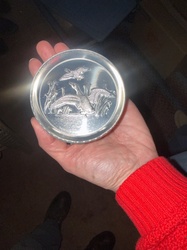
Imari platter

AI analysis below

AI appraisal

AI analysis & estimate

AI-Generated · Verify before acting

Everything below is generated by AI for informational purposes only. AI can make mistakes — the AI may misidentify items or misattribute them (artist, maker, brand, designer, origin, era). This is not an official valuation and should not be used for insurance, sale, tax, estate, legal, or lending purposes — or any decision requiring a certified appraisal. It is not an authoritative claim about any person, brand, or rights holder — do not share or rely on it as a factual statement about a third party. Always consult qualified professionals before making financial decisions.

Note

This analysis also relies on unverified notes provided by the user, which may be incomplete or inaccurate and could affect the result.

Read the full disclaimer

AI Identification

·Not independently authenticated·Verify before acting

Silver-Plated Metal Platter Base with Hallmarks

Antique Metalware / Silverplate

AI Estimated Value

·Not an official valuation·Verify before acting

$40-75

As of June 12, 2026

AI Item Analysis

·AI can make mistakes·Verify before acting
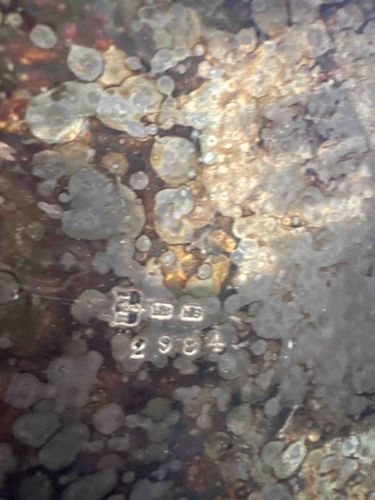
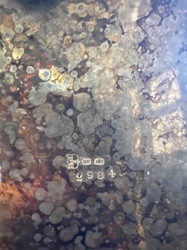
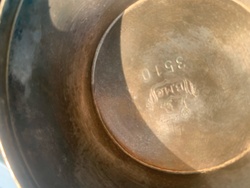
This item is the metallic underside of a platter, specifically identified as part of an Imari-style serving set. The surface is heavily weathered, exhibiting significant oxidation, pitting, and loss of original plating, revealing the underlying base metal, likely a copper alloy or nickel silver. The most prominent feature is a set of stamped hallmarks and a pattern number '2984'. The markings include a Gothic-style 'B' or 'D' inside a shield, followed by smaller square stamps containing letters, which are consistent with English electroplate manufacturers like Barker Brothers or similar silversmiths from the late 19th to early 20th century (Victorian or Edwardian eras). The condition shows extensive tarnish ('patina') and what appears to be chemical corrosion or heat damage resulting in a mottled, circular spotting pattern across the metal surface. There is no evidence of structural cracking, but the decorative plating is largely compromised. The presence of a 4-digit serial/pattern number indicates a standardized manufacturing process by a reputable silver-plating firm. The craftsmanship is evident in the precision of the die-stamped marks despite the severe surface degradation.
AI Appraisal Report

·AI can make mistakes·Verify before acting
I have conducted a remote examination of the silver-plated metal platter base, identified as pattern number 2984. The hallmarks observed (Gothic-style letter and square stamps) are consistent with late 19th-century British silverplate manufacturers, likely Barker Brothers. Based on the stamping, the piece is a Victorian or Edwardian electroplated nickel silver (EPNS) frame designed to hold an Imari porcelain insert. The condition is significantly compromised. My visual assessment reveals severe oxidation, pitting, and 'bleeding'—where the silver plating has worn away to reveal the base metal. The mottled, circular spotting suggests exposure to harsh chemicals or extreme moisture, which has deeply etched the surface beyond simple tarnish. While the structure remains intact, the loss of nearly 80-90% of the original plating greatly diminishes its aesthetic and collector value. In the current market, decorative mounts for Imari ware have low liquidity unless accompanied by the original porcelain. As a standalone base in 'poor' to 'fair' condition, it is valued primarily as a replacement part or for repurposing. Rare patterns or solid sterling mounts might command higher prices, but this mass-produced electroplate item remains at the lower end of the valuation spectrum. Limitation of Authenticity: This appraisal is based solely on digital images. Without physical inspection, I cannot verify the exact metal composition (e.g., sterling vs. EPNS) or the depth of the corrosion. Full authentication would require an in-person acid test of the metal under the plating and a review of provenance documentation or catalog records for 'Pattern 2984' to confirm the specific manufacturer and production year.

Get your items appraised

Instant estimates of your treasures with AI-powered appraisals

Browse More Appraisals