Weatheron Stemmed Projectile Point Fragment
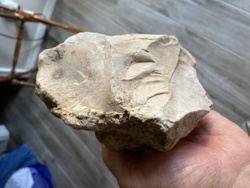
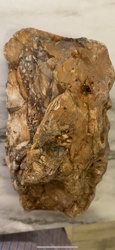
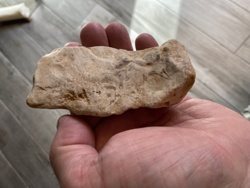
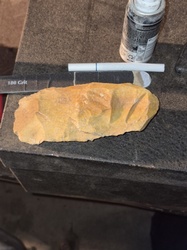
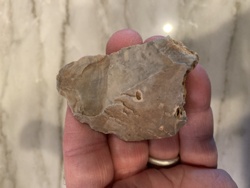
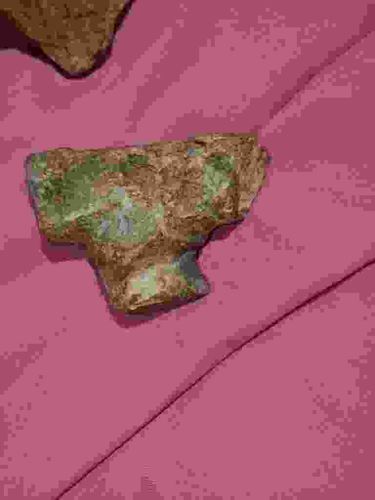
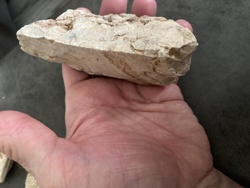
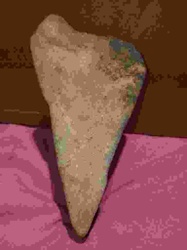
This artifact is a lithic projectile point, likely a stemmed or bifurcated variant, crafted from a chert or flint-based stone. The object exhibits a primarily brownish-tan body with notable patches of green surface coloration, which may indicate mineral staining, presence of copper oxides, or lichen growth depending on the burial environment. The piece shows evidence of bifacial pressure flaking, though the edges appear heavily weathered and rolling. The base features a distinct contracting or slightly expanding stem, while the shoulder is asymmetrical, suggesting a fracture across the blade. The surface texture is rough and pitted, indicating significant environmental exposure and chemical weathering over a long period. No modern tool marks are visible, pointing toward ancient manufacture. The piece likely dates to the Archaic period based on the general morphology of the stem and shoulder junction. Condition is poor to fair, as it is a fragment lacking the distal tip. The patina is thick and consistent across the flaked scars, suggesting the piece has not been recently reworked. The lack of secondary retouch suggests it may have been a discarded preform or a tool that suffered a terminal impact fracture during use.
AI-Generated Appraisal Disclaimer
Estimated Value
$45-85
Basic Information
Category
Archaeological Artifacts / Lithics
Appraised On
March 28, 2026
Estimated Value
$45-85
Item Description
This artifact is a lithic projectile point, likely a stemmed or bifurcated variant, crafted from a chert or flint-based stone. The object exhibits a primarily brownish-tan body with notable patches of green surface coloration, which may indicate mineral staining, presence of copper oxides, or lichen growth depending on the burial environment. The piece shows evidence of bifacial pressure flaking, though the edges appear heavily weathered and rolling. The base features a distinct contracting or slightly expanding stem, while the shoulder is asymmetrical, suggesting a fracture across the blade. The surface texture is rough and pitted, indicating significant environmental exposure and chemical weathering over a long period. No modern tool marks are visible, pointing toward ancient manufacture. The piece likely dates to the Archaic period based on the general morphology of the stem and shoulder junction. Condition is poor to fair, as it is a fragment lacking the distal tip. The patina is thick and consistent across the flaked scars, suggesting the piece has not been recently reworked. The lack of secondary retouch suggests it may have been a discarded preform or a tool that suffered a terminal impact fracture during use.
Get Your Items Appraised
Instant estimates of your treasures with AI-powered instant appraisals