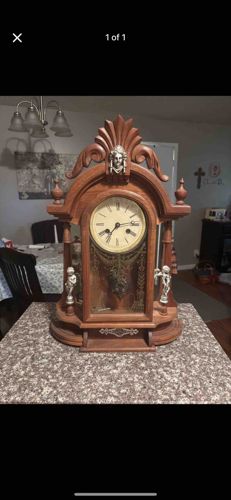
Victorian Era Style gingerbread Mantel Clock
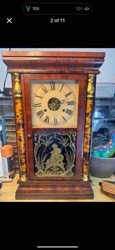
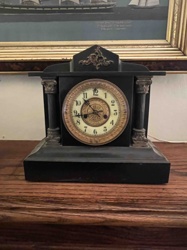
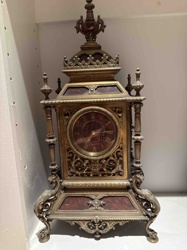
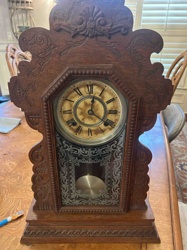
This is a detailed Victorian-style mantel clock, commonly referred to as a 'gingerbread clock,' likely dating from the late 19th or early 20th century. Constructed from solid oak with a warm honey finish, it features an elaborate arching crest crowned with a fan-shaped finial and a distinctive die-cast metal 'Ladies Head' plaque. The clock's architecture includes side pillars supported by small turned finials and flanked by two silver-toned cherub figurines on pedestals. The round cream-colored dial features Roman numerals, dual winding arbors for a time-and-strike movement, and ornate metal hands protected by a glass door. The lower glass panel is beautifully stenciled with gold-toned scrollwork, partially obscuring a brass pendulum. Condition-wise, the wood appears well-preserved with a natural aged patina, though there is minor surface wear consistent with age, particularly on the base. The metal components show slight tarnishing. The craftsmanship is typical of American clock manufacturers from the 1880-1910 period, such as Ansonia, Gilbert, or Seth Thomas, noted for combining mass-produced wooden cases with elegant decorative cast-metal hardware.
AI-Generated Appraisal Disclaimer
Estimated Value
$450 - $650
Basic Information
Category
Antique Horology / Clocks
Appraised On
February 14, 2026
Estimated Value
$450 - $650
Item Description
This is a detailed Victorian-style mantel clock, commonly referred to as a 'gingerbread clock,' likely dating from the late 19th or early 20th century. Constructed from solid oak with a warm honey finish, it features an elaborate arching crest crowned with a fan-shaped finial and a distinctive die-cast metal 'Ladies Head' plaque. The clock's architecture includes side pillars supported by small turned finials and flanked by two silver-toned cherub figurines on pedestals. The round cream-colored dial features Roman numerals, dual winding arbors for a time-and-strike movement, and ornate metal hands protected by a glass door. The lower glass panel is beautifully stenciled with gold-toned scrollwork, partially obscuring a brass pendulum. Condition-wise, the wood appears well-preserved with a natural aged patina, though there is minor surface wear consistent with age, particularly on the base. The metal components show slight tarnishing. The craftsmanship is typical of American clock manufacturers from the 1880-1910 period, such as Ansonia, Gilbert, or Seth Thomas, noted for combining mass-produced wooden cases with elegant decorative cast-metal hardware.
Get Your Items Appraised
Instant estimates of your treasures with AI-powered instant appraisals