These notes were written by the person who submitted this item. Appraiser.AI has not verified them, and the AI's identification and estimate may rely on them.
AI Estimated Value
Not an official valuation
$250-400
AI estimate as of November 19, 2025 · verify with a professional before acting
AI-Generated · Verify before acting
Everything on this page is generated by AI for informational purposes only. AI can make mistakes — the AI may misidentify items or misattribute them (artist, maker, brand, designer, origin, era). This is not an official valuation and should not be used for insurance, sale, tax, estate, legal, or lending purposes — or any decision requiring a certified appraisal. It is not an authoritative claim about any person, brand, or rights holder — do not share or rely on it as a factual statement about a third party. Always consult qualified professionals before making financial decisions.
This analysis also relies on unverified notes provided by the user, which may be incomplete or inaccurate and could affect the result.
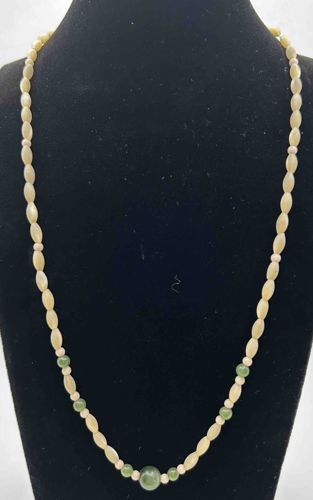
This is a vintage beaded necklace, likely from the mid-20th century, characterized by a harmonious blend of natural materials. The primary beads are elongated, oval-shaped beige or off-white beads, possibly representing coral, given their texture and color variation. These larger beads are uniformly sized and distributed throughout the necklace, creating a consistent rhythm. Interspersed between these lighter beads are smaller, round, pale pink beads, suggesting either very light pink coral or perhaps another shell material. The necklace also features prominent dark green, round beads, which appear to be jade due to their characteristic mottled green coloration and semi-translucent quality. There is a single, larger dark green bead centrally placed at the bottom of the necklace, acting as a focal point. Flanking this central bead, and continuing up the sides of the necklace at regular intervals, are pairs of smaller dark green beads. The construction appears to be strung on a durable thread, though the clasp is not visible in the provided image. The beads exhibit minor natural variations in color and surface texture, consistent with organic materials. No significant damage such as chips, cracks, or repairs are immediately evident, suggesting good preservation. The overall craftsmanship appears to be hand-strung, indicative of artisanal jewelry from its likely period. The design is simple yet elegant, relying on the natural beauty and color contrast of the stones.
AI Appraisal Report
Based on my visual examination of the provided image, this vintage beaded necklace presents as a well-preserved piece, likely from the mid-20th century. The overall condition appears good, with no visible chips, cracks, or significant damage to the beads. The elongation of the main beige/off-white beads, coupled with their texture and color variation, strongly suggests natural coral. The smaller, round pale pink beads are also consistent with light pink coral or shell. The dark green, mottled, and semi-translucent round beads align well with the characteristics of natural jade. The single central larger jade bead and regularly spaced pairs enhance the design and focal point. The hand-strung appearance is consistent with artisanal jewelry from its likely period, contributing to its vintage appeal.
In terms of market conditions, vintage coral and jade jewelry, particularly those with natural, undyed stones, generally hold consistent demand. Comparables in the online vintage market show similar necklaces ranging from $150 to $500, depending on the quality, size, and quantity of materials. The simple yet elegant design relies on the inherent beauty of the stones, which appeals to collectors of naturalistic vintage jewelry. While not exceptionally rare, the combination of these specific materials in good condition maintains a steady interest.
Factors impacting this value include the natural materials and good preservation. However, it is crucial to note the limitations of this appraisal. Without a physical inspection, I cannot definitively confirm the authenticity of the coral or jade. In-person examination would allow for closer scrutiny of bead uniformity, weight, and surface characteristics. More importantly, scientific testing (e.g., specific gravity, refractive index for gemstones) would be needed to conclusively authenticate the materials as natural coral and jade. Furthermore, the clasp, which can sometimes be a significant indicator of age and quality, is not visible. If the coral is dyed, or the jade is heavily treated or a simulant, the value would be significantly lower. Provenance documentation, if available, would also add to the item's valuation.