AI estimate as of November 18, 2025 · verify with a professional before acting
AI-Generated · Verify before acting
Everything on this page is generated by AI for informational purposes only. AI can make mistakes — the AI may misidentify items or misattribute them (artist, maker, brand, designer, origin, era). This is not an official valuation and should not be used for insurance, sale, tax, estate, legal, or lending purposes — or any decision requiring a certified appraisal. It is not an authoritative claim about any person, brand, or rights holder — do not share or rely on it as a factual statement about a third party. Always consult qualified professionals before making financial decisions.
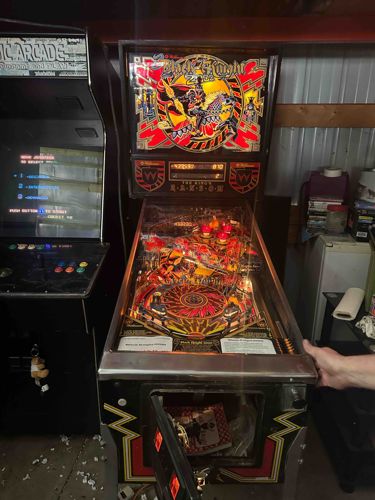
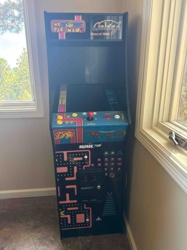
This is a vintage Williams 'Black Knight' pinball machine, easily identifiable by the distinctive 'Black Knight' artwork on the backglass and playfield. The machine features a bold color scheme predominantly in black, red, and gold, with metallic silver accents on the cabinet trim and playfield rails. The backglass displays a medieval-themed illustration of a knight on horseback, rendered in a striking graphic style with a red and yellow circular motif. Below the backglass is a score display panel, showing what appears to be a digital score of '7280' and '010', flanked by two shields with a 'W' emblem, indicating the Williams manufacturer. The playfield is brightly lit, showcasing various targets, bumpers, and ramps in red, yellow, and black. A prominent feature on the playfield is a large, circular graphic with a spiral design, typical of intricate pinball machine layouts from this era. The cabinet itself is black with red and gold lightning bolt or chevron-like graphics on the side, characteristic of 1980s arcade machine designs. Visible condition issues include what appears to be some wear on the cabinet, particularly around the coin door area, which is partially open, revealing internal components or storage. There are also small white debris or chips on the floor directly below the coin door, suggesting potential scuffing or material loss from the machine or its surroundings. The metal trim appears somewhat scuffed. The craftsmanship is typical of arcade machines from its period, designed for durability and engaging gameplay, with intricate artwork and mechanical complexity. The machine appears to be in an operational or at least partially operational state, given the illuminated playfield and score display. This model is known for being one of the first pinball machines to feature an upper playfield and 'Magna-Save' function.
AI Appraisal Report
Based on my visual examination of the provided image, I can confirm this is an authentic Williams 'Black Knight' pinball machine, easily identifiable by its distinctive backglass, playfield artwork, and cabinet graphics, consistent with models produced in 1980. The illuminated playfield and score display suggest it is in at least partially operational condition, a significant value factor. However, I note several condition issues: wear on the cabinet, particularly around the coin door area which is partially open, and visible scuffing on the metal trim. The small debris on the floor below the coin door could indicate material loss or just general grime. These issues suggest the machine is not in collector-grade condition but rather a good player's condition, likely requiring some restoration or significant cleaning.
'Black Knight' is a highly sought-after title within the pinball community, notable for being groundbreaking with its upper playfield and 'Magna-Save' feature, which contributes significantly to its demand and rarity. Market comparables for fully restored or excellent condition models typically range from $5,000 to $7,000, while unrestored but working units often fall into the $3,000 to $4,500 range, depending on the extent of wear and functionality. Given the visible cosmetic wear, I would place this particular example in the lower-to-mid end of that unrestored working range.
Limitations to this appraisal include the inability to definitively assess internal component wear, full operational status, sound functionality, or playfield wear not visible in the image. An in-person examination would be required to verify all internal components, confirm full playfield integrity (e.g., pop bumper strength, flipper power, playfield wear under plastics), and assess the extent of cabinet damage more accurately. Provenance documentation (e.g., original sales receipts, service history) would further authenticate its ownership history and could slightly impact value, but its iconic design largely self-authenticates the model type.