AI estimate as of August 25, 2025 · verify with a professional before acting
AI-Generated · Verify before acting
Everything on this page is generated by AI for informational purposes only. AI can make mistakes — the AI may misidentify items or misattribute them (artist, maker, brand, designer, origin, era). This is not an official valuation and should not be used for insurance, sale, tax, estate, legal, or lending purposes — or any decision requiring a certified appraisal. It is not an authoritative claim about any person, brand, or rights holder — do not share or rely on it as a factual statement about a third party. Always consult qualified professionals before making financial decisions.
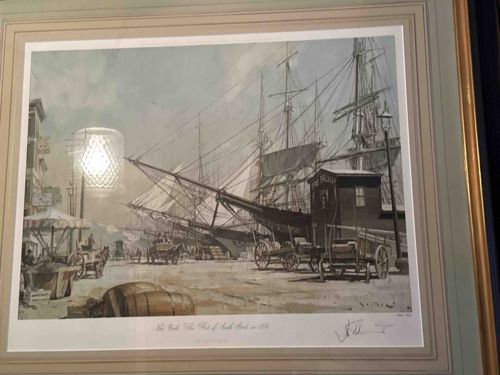
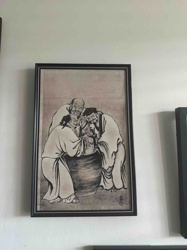
The item is a framed print depicting a historical harbor scene, likely a busy port with tall ships docked. The print is housed under glass and is set within a light-colored, possibly wooden or composite, frame with a simple profile. There is a visible mat board in a white or off-white color surrounding the print, creating a clean boundary between the artwork and the frame. The artwork itself is a color print, appearing to be a lithograph or similar reproduction technique, given the general clarity and color application. The dominant colors in the print are muted blues, grays, and browns, with touches of greens and reds in the foreground elements like barrels and market stalls, suggesting a somewhat overcast or characteristic port day.
The scene features multiple large sailing vessels with intricate rigging, indicative of the 18th or 19th century. On the waterfront, there are various activities including market stalls with awnings, horse-drawn carts, and figures of people, adding to the dynamic nature of the bustling port. The foreground shows a large wooden barrel lying on its side, contributing to the sense of an active loading/unloading area. A distinctive feature is the text at the bottom center, which reads "The New York Port of South Street in 1818" (though 'South Street' and '1818' are slightly obscured by glare), indicating the specific location and year of the depicted scene. To the right of this text, there is a prominent hand-signed signature, which appears to be 'J.M.W.' or similar, suggesting a limited edition print signed by the artist or a significant figure. The condition of the print appears good, with no visible tears or significant discoloration, though the glare on the glass prevents a full assessment. The frame also seems to be in good condition with minor wear consistent with display. The reflective glare from the light source indicates the presence of a glass or acrylic cover for protection. The overall craftsmanship suggests a commercially produced framed print, likely intended for decorative purposes, with the potential added value of the artist's signature.
AI Appraisal Report
I have examined the image provided for the framed print 'The New York Port of South Street in 1818'. The item appears to be a commercially produced color print, likely a lithograph or similar reproduction, framed under glass with a mat. The condition, based purely on the image, appears good; I see no obvious tears or significant discoloration, and the frame seems to have only minor wear. However, glare on the glass prevents a full assessment of the artwork's surface condition. The presence of a hand-signed signature, possibly 'J.M.W.', suggests this is a limited edition print, which adds value. The historical subject matter depicting a specific, recognizable location and year ('1818' and 'South Street', though slightly obscured) can appeal to collectors of Americana or maritime art.
Market conditions for decorative framed prints vary widely. While historical scenes have a consistent audience, prints of this nature, unless by a highly renowned artist or part of an exceptionally rare series, typically fall into the lower to mid-range of the art market. The specific subject matter of old New York can enhance demand among local history enthusiasts. Rarity is difficult to assess without knowing the edition size and the artist's notoriety.
Factors significantly impacting value are the authenticity and prominence of the signature, the exact reproduction technique, and the print's edition number. Without physical inspection, I cannot definitively verify the authenticity of the signature, nor can I determine if it's a genuine artist's signature or that of a publisher/printer. An in-person examination would be needed to assess the true condition of the print (e.g., foxing, fading, acid burn), the quality of the paper, and the authenticity of the signature through direct comparison with known examples. Provenance documentation (e.g., certificate of authenticity, sales receipts) would be crucial for establishing the print's history and the signature's authenticity. Scientific testing, such as ink analysis for the signature, could also provide definitive answers.