AI estimate as of October 17, 2025 · verify with a professional before acting
AI-Generated · Verify before acting
Everything on this page is generated by AI for informational purposes only. AI can make mistakes — the AI may misidentify items or misattribute them (artist, maker, brand, designer, origin, era). This is not an official valuation and should not be used for insurance, sale, tax, estate, legal, or lending purposes — or any decision requiring a certified appraisal. It is not an authoritative claim about any person, brand, or rights holder — do not share or rely on it as a factual statement about a third party. Always consult qualified professionals before making financial decisions.
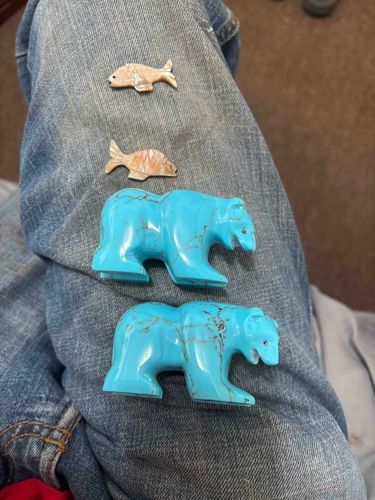
This collection comprises four hand-carved animal fetishes: two bears and two fish. The two bear carvings are crafted from a vibrant, opaque, sky-blue turquoise, exhibiting natural matrix inclusions, which appear as dark brown or black veining and splotches throughout the stones. These inclusions are particularly prominent on the back, sides, and heads of the bears. The bears are depicted in a walking or standing posture, with simplified, rounded forms characteristic of traditional Southwestern fetish carvings. Each bear measures approximately 2.5 to 3 inches in length and possesses a smooth, polished finish that highlights the natural beauty of the turquoise. Their mouths are slightly agape, suggesting a breathing or roaring pose, and their eyes are rudimentary indentations or left undetailed. The two fish carvings are made from a lighter-colored material, likely shell, possibly mother-of-pearl or similar. One fish shows a light beige hue with subtle, iridescent markings, while the other features a warmer, light peach or salmon color with distinct striped patterns. Both fish are carved in a side profile, with fins and tails clearly delineated, albeit in a stylized manner. They are smaller than the bears, each measuring roughly 1.5 to 2 inches in length. There are no readily visible maker's marks, signatures, or stamps on any of the pieces from the provided image. The overall style suggests a Native American or Southwestern folk art origin, likely from the mid to late 20th century. The condition appears to be good, with no obvious chips or cracks, only the natural variations and matrix of the stones.
AI Appraisal Report
I have examined the provided image of the collection of four hand-carved animal fetishes, comprising two turquoise bears and two shell fish. The condition of these pieces appears to be good, with no obvious chips or cracks visible in the image. The turquoise bears exhibit natural matrix inclusions, which are typical for this material and add to their authenticity as natural stone carvings. The shell fish also show natural variations in color and pattern. The style is consistent with Native American or Southwestern folk art, likely dating from the mid to late 20th century. However, authenticity cannot be definitively confirmed from an image alone; an in-person examination would be required to verify the carving techniques, material composition, and to search for any hidden maker's marks not visible in the provided view. Provenance documentation, such as original purchase receipts or artist attribution, would also significantly enhance authentication.
In terms of market conditions, carved stone and shell fetishes, particularly those of Native American origin, generally maintain a steady demand within the folk art and collectible markets. Individual pieces of this size and material typically sell in the range of $50 to $150 each, depending on the artist, specific quality of carving, and material. Given this collection of four pieces, with two in desirable turquoise, the aggregate value is higher. Rarity is moderate; while individual fetishes are common, collections of well-matched pieces in good condition have slightly more appeal. Factors impacting value include the material quality (the vibrant turquoise is a positive), the artistry of the carving (simplified but appealing), and the good apparent condition. Without artist attribution or detailed provenance, the value remains in the general folk art category rather than as a recognized artist's work. My appraisal is based on the visual evidence, assuming they are authentic folk art pieces as described. For full authentication, physical inspection by a recognized expert, and potentially material testing, would be needed.