AI Appraisal Estimate

AI-generated estimates · not official valuations

From the user

What was submitted

Photo and notes provided by the user — not generated by AI

Submitted item photo
Submitted photo · May 24, 2026

User's notes

No additional notes provided.

AI analysis below

AI appraisal

AI analysis & estimate

AI-Generated · Verify before acting

Everything below is generated by AI for informational purposes only. AI can make mistakes — the AI may misidentify items or misattribute them (artist, maker, brand, designer, origin, era). This is not an official valuation and should not be used for insurance, sale, tax, estate, legal, or lending purposes — or any decision requiring a certified appraisal. It is not an authoritative claim about any person, brand, or rights holder — do not share or rely on it as a factual statement about a third party. Always consult qualified professionals before making financial decisions.

Read the full disclaimer

AI Identification

·Not independently authenticated·Verify before acting

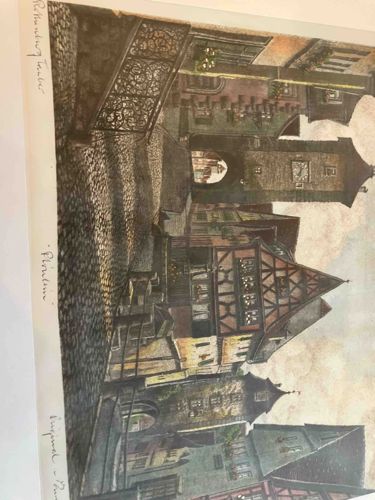
Rothenburg Tauber Plönlein Color Etching

Fine Art Prints

AI Estimated Value

·Not an official valuation·Verify before acting

$100.00 - $175.00

As of May 24, 2026

AI Item Analysis

·AI can make mistakes·Verify before acting
This item is a hand-colored etching or lithograph depicting the famous 'Plönlein' corner in Rothenburg ob der Tauber, Germany. The piece showcases a vertical composition of a narrow half-timbered house flanked by the Sieber Tower and the Kobolzeller Gate. The artwork utilizes a muted, naturalistic color palette featuring earthen reds, ochre yellows, and cool greys against a textured sky. The foreground is dominated by a detailed cobblestone street that provides a sense of depth and perspective. The craftsmanship is evidenced by the fine line work typical of architectural prints from the early to mid-20th century. Notable handwritten pencil inscriptions are visible in the left margin, including the title 'Rothenburg Tauber', the location 'Plönlein', and a notation that appears to say 'Original - Radierung' (Original Etching). The paper shows signs of age-appropriate toning and minor foxing or soiling along the white margins. The print appears to be on a medium-weight cream paper stock. There is a slight ripple to the page consistent with moisture exposure or previous framing. The architectural style captures the medieval essence of Bavaria, and the print likely dates from approximately 1920 to 1950, a peak period for European souvenir etchings of this quality.

AI Appraisal Report

·AI can make mistakes·Verify before acting
I have completed a visual inspection of the hand-colored etching titled 'Rothenburg Tauber - Plönlein.' Based on my analysis, the piece is a mid-century 'souvenir' etching, likely produced between 1920 and 1950. The technique involves a printed copper-plate base with hand-applied watercolor washes. The inscriptions 'Original Radierung' and the pencil title are consistent with European printmaking standards of the era. The condition is fair to good; while the central image remains vibrant, the margins show age-related toning, minor foxing, and rippling, likely from acidic backing or fluctuations in humidity. The market for 20th-century German architectural etchings is stable but saturated. Works by prolific artists of this genre, such as Luigi Kasimir or Ernst Geissendörfer, command higher premiums. Without a definitive artist signature, this piece is valued primarily on its decorative merit and the timeless appeal of the Rothenburg iconography. Comparable sales for unsigned or minor-artist etchings of this size and condition typically fall within the $100-$175 range. Please note that this appraisal is based on digital images and carries inherent limitations. A full authentication would require a physical inspection to confirm the presence of a plate mark (indicating a true etching versus a photomechanical reproduction) and to examine the paper’s watermark for precise dating. Microscopic analysis of the pigment would also be necessary to confirm the hand-coloring is period-correct and not modern digital over-printing. Finally, provenance paperwork or a gallery label on the original frame backing would provide significant clarity on the artist’s identity, which could potentially increase the valuation.

Get your items appraised

Instant estimates of your treasures with AI-powered appraisals

Browse More Appraisals