AI estimate as of August 22, 2025 · verify with a professional before acting
AI-Generated · Verify before acting
Everything on this page is generated by AI for informational purposes only. AI can make mistakes — the AI may misidentify items or misattribute them (artist, maker, brand, designer, origin, era). This is not an official valuation and should not be used for insurance, sale, tax, estate, legal, or lending purposes — or any decision requiring a certified appraisal. It is not an authoritative claim about any person, brand, or rights holder — do not share or rely on it as a factual statement about a third party. Always consult qualified professionals before making financial decisions.
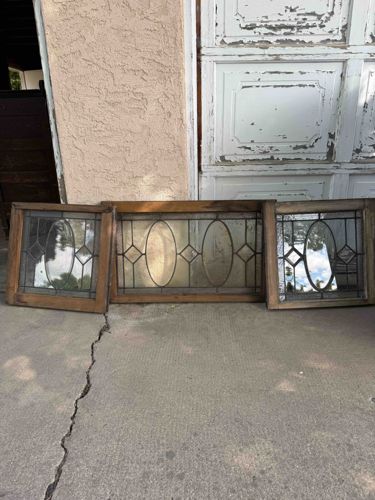
This lot consists of three antique or vintage stained-glass and leaded-glass window panels, likely originally transom windows or decorative inserts. Each panel features a distinct design, encased within a wooden frame of what appears to be oak or a similar hardwood, exhibiting a natural, possibly varnished, finish that has darkened with age. The frames show signs of wear consistent with their age and previous installation, including surface scratches, minor dings, and some loss of finish, revealing the underlying wood. The glass elements vary; two end panels feature predominantly clear, possibly beveled, glass with diamond and oval shapes creating geometric patterns, joined by lead cames. The central and largest panel incorporates amber-toned or lightly tinted glass in an oval pattern, alongside clear rectangular and diamond-shaped panes, also held together by lead cames. The lead lines in all panels exhibit typical oxidation and slight bending in places, indicating their age and hand-assembled nature. Some dust and dirt are visible on the glass and within the lead channels, but no immediate cracks or significant breaks are discernible in the glass from the image. The craftsmanship suggests a period between the late 19th century and early 20th century, consistent with Victorian or Arts and Crafts architectural styles. The overall condition is good for age but shows appropriate patina and surface wear. These panels would have been high-quality decorative elements in a period home, showcasing skilled leaded and possibly stained glass artistry. There are no visible maker's marks or signatures.
AI Appraisal Report
Upon my virtual examination of the provided image, this lot of three antique/vintage leaded and stained glass window panels presents as authentic period architectural salvage, likely dating from the late 19th to early 20th century. The geometric patterns, use of lead cames, and type of wood framing (suggesting oak) are consistent with Victorian or Arts and Crafts styles. The condition, showing appropriate patina, wear to the frames, and oxidation of the lead, is good for its age, affirming authenticity rather than reproduction. The absence of visible cracks or significant damage to the glass is a positive factor.
Market demand for genuine architectural salvage, particularly well-preserved stained or leaded glass, remains steady. These panels offer versatile decorative use, enhancing their appeal. Comparables for sets of three distinct, multi-paneled antique windows in good condition typically fetch prices at the higher end of the range. The distinct designs of each panel add to their unique character and desirability. Rarity is moderate; while individual panels are common, a cohesive set of three of this quality is less so.
Key factors impacting value positively include the good overall condition, the complete set of three, and the aesthetic appeal of the designs. The lack of discerning breaks in the glass also significantly contributes. Limitations in authenticity verification from images alone include the inability to fully assess glass integrity (e.g., subtle hairline cracks, stress fractures), lead cames' structural stability (e.g., lead fatigue), or wood rot within the frames. An in-person examination would allow for tactile inspection of the glass, lead, and wood, assessment of bowing or structural issues, and identification of any repairs. Provenance documentation, if available, would further enhance value and certainty of origin. Scientific testing, while possible for glass composition, is usually not practical or necessary for standard architectural salvage appraisal unless specific material authentication is in question.