AI estimate as of September 7, 2025 · verify with a professional before acting
AI-Generated · Verify before acting
Everything on this page is generated by AI for informational purposes only. AI can make mistakes — the AI may misidentify items or misattribute them (artist, maker, brand, designer, origin, era). This is not an official valuation and should not be used for insurance, sale, tax, estate, legal, or lending purposes — or any decision requiring a certified appraisal. It is not an authoritative claim about any person, brand, or rights holder — do not share or rely on it as a factual statement about a third party. Always consult qualified professionals before making financial decisions.
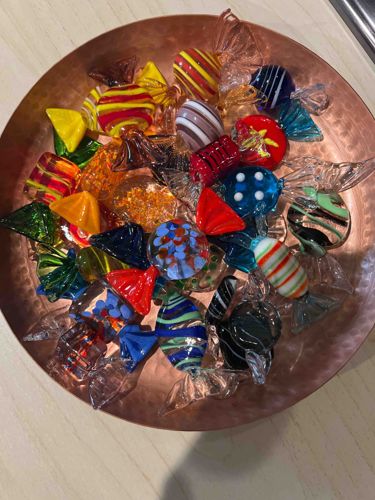
This item comprises a collection of approximately 25-30 individual hand-blown glass sculptures, each artfully crafted to resemble wrapped candies, presented within a polished copper bowl. The candies exhibit a wide variety of shapes, sizes, and colors, mimicking hard candies, bonbons, and wrapped sweets. Each piece features a central 'candy' body and two 'wrapper' ends, which are typically clear or subtly tinted glass, twisted to suggest the packaging. Colors range from vibrant reds, yellows, blues, oranges, and greens to more muted browns, grays, and whites. Many pieces showcase intricate internal designs, including striped patterns (e.g., red and yellow stripes, white and brown stripes, green and blue swirls), polka dots (e.g., blue with white dots), or mosaic-like inclusions of various colored glass chips. A few pieces have unique accents, such as a yellow bee design on a red candy, or a red heart shape. The glass appears to be of high quality, exhibiting a clear, unblemished surface with good translucency, indicating skilled glassblowing techniques. The craftsmanship is evident in the seamless integration of colors and patterns, and the formation of the delicate 'wrapper' elements. There are no visible chips, cracks, or significant wear to the glass pieces, suggesting excellent preservation or careful handling. The copper bowl, which serves as the display vessel, is circular, with a slightly hammered or textured surface that gives it a rustic yet refined appearance, enhancing the visual appeal of the colorful glass within. The bowl shows a warm, reddish-brown hue, characteristic of copper, with a slight sheen that suggests a polished finish. There are no obvious dents or severe patina on the bowl, indicating good condition. The overall presentation suggests a decorative art piece, likely created in the late 20th or early 21st century, designed for aesthetic pleasure rather than utility. The varying designs and forms suggest they may come from a single artist or studio known for glass art, potentially inspired by Murano glass traditions.
AI Appraisal Report
Based on my visual examination of the provided image, this Assorted Hand-Blown Glass Candies in Copper Bowl presents as a charming and well-executed decorative art piece. The condition of the glass candies appears excellent; I observe no chips, cracks, or significant wear. The vibrant colors, varied shapes, and intricate internal patterns (stripes, polka dots, unique accents) suggest good craftsmanship and attention to detail. The 'wrapper' ends are delicately formed, enhancing the illusion of actual candies. The copper bowl also appears to be in very good condition, with a pleasing texture and finish, showing no obvious dents or excessive patina. Its warmth complements the colorful glass.
In terms of market conditions, decorative hand-blown glass, especially whimsical pieces like these, typically garners moderate demand within the secondary art and collectibles market. Comparables for unsigned, decorative glass art of this nature suggest a value range. While the quality is evident, the lack of a discernible artist's signature or studio mark limits its top-tier value potential. Were these verifiable Murano pieces or attributed to a highly recognized glass artist, the value would be significantly higher. There is no inherent rarity, but the sheer quantity (25-30 pieces) and the consistent quality within the collection contribute positively.
My primary limitation in this appraisal is the reliance on images alone. While I assess condition based on visual cues, physical inspection would confirm the absence of hairline cracks, subtle scuffs, or internal flaws not visible in photographs. Authenticity of the glass as 'hand-blown' is strongly suggested by the variations and organic forms but would ideally be confirmed by in-person examination for pontil marks, wall thickness consistency, and internal bubbles characteristic of the technique. Provenance documentation could authenticate origin or artist. Scientific testing is not typically required for items of this nature unless specific material identification is in question, which is not the case here.