AI identification & appraisal estimate

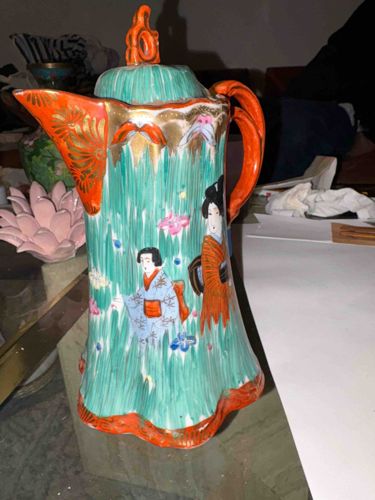
Japanese Imariware-Style Figural Coffee Pot

Submitted photo of Japanese Imariware-Style Figural Coffee Pot
Photo submitted by the user — not generated by AI

AI Estimated Value

Not an official valuation

$125 - $225

AI estimate as of September 19, 2025 · verify with a professional before acting

AI-Generated · Verify before acting

Everything on this page is generated by AI for informational purposes only. AI can make mistakes — the AI may misidentify items or misattribute them (artist, maker, brand, designer, origin, era). This is not an official valuation and should not be used for insurance, sale, tax, estate, legal, or lending purposes — or any decision requiring a certified appraisal. It is not an authoritative claim about any person, brand, or rights holder — do not share or rely on it as a factual statement about a third party. Always consult qualified professionals before making financial decisions.

Read the full disclaimer

AI Item Analysis

This is a tall, slender coffee pot made of porcelain or ceramic, exhibiting a vibrant and highly decorative Imariware-style aesthetic. Its dominant color scheme features a bright teal or turquoise-green ground, hand-painted with vertical brushstrokes creating a grassy or flowing fabric effect. The pot has a flared base and tapers upwards to a narrower neck, topped with a fitted lid. The spout is notably elongated and angled, painted in a rich terracotta or burnt orange color, detailed with intricate gold leaf or gilt scrollwork designs. The handle, also in the same terracotta/orange, is ribbed or molded to resemble twisted bamboo or branches, curling elegantly from the rim to the mid-body. The lid features a complex finial, possibly depicting a stylized flame or floral motif, rendered in the same terracotta/orange. The body of the pot is adorned with hand-painted figural scenes of what appear to be Japanese-style women or geishas in traditional attire, each distinct in their colorful kimonos, set against the teal background with scattered floral elements in pink, blue, and white. The rim of the pot and the base are edged with the same terracotta/orange color, with the base exhibiting a wavy, almost scalloped border. The quality of the hand-painting suggests a level of craftsmanship, though some brushstrokes appear somewhat broad. Observable condition issues include potential wear to the gilt details and some possible flaking or chipping on the painted surfaces, particularly around the edges and raised areas like the handle and finial, indicating use or age. The overall style suggests an influence from Japanese Imari export ware, likely dating from the late 19th to early 20th century. No clear manufacturer's marks or signatures are visible from this angle, but such items often bear marks on the base.
AI Appraisal Report

Upon visual examination of this Japanese Imariware-style figural coffee pot, I can assess its characteristics and offer a preliminary valuation. The piece exhibits a vibrant, hand-painted decorative scheme typical of Japanese export porcelain from the late Meiji to Taisho periods (circa 1890-1920s), often referred to as 'Geisha ware' or simply Imari-style. The form, with its tall body and elongated spout, is distinctive. The hand-painting, featuring figural scenes against a teal ground, shows a good level of craftsmanship, though the brushwork is somewhat broad, suggesting a piece made for the Western export market rather than the highest-end domestic market. The condition, as observed from the images, shows signs of age and use, including visible wear to the gilt details on the spout and handle, and potential minor flaking on the painted surfaces and finial. These condition issues are typical for items of this age and modestly temper the value. The market for this type of Japanese export porcelain is relatively stable. While intricate, high-quality Imari pieces command strong prices, 'Geisha ware' is more common and thus more accessible. Comparable coffee pots in similar condition typically sell in the low to mid-hundreds at auction. The primary factor limiting the value is its likely production for a mass-export market, making it less rare than earlier or more artistically refined examples. For full authentication, an in-person examination is essential to inspect for a maker's mark or signature on the underside, which could significantly alter the value. I would also need to assess the porcelain body for quality, check for any hidden repairs under blacklight, and more accurately gauge the extent of the wear to the enamel and gilding.

Keep exploring

More ceramics and porcelain appraisals

Get your items appraised

Instant AI-powered appraisal estimates from a photo

Browse More Appraisals