These notes were written by the person who submitted this item. Appraiser.AI has not verified them, and the AI's identification and estimate may rely on them.
AI Estimated Value
Not an official valuation
$50 - $100
AI estimate as of November 11, 2025 · verify with a professional before acting
AI-Generated · Verify before acting
Everything on this page is generated by AI for informational purposes only. AI can make mistakes — the AI may misidentify items or misattribute them (artist, maker, brand, designer, origin, era). This is not an official valuation and should not be used for insurance, sale, tax, estate, legal, or lending purposes — or any decision requiring a certified appraisal. It is not an authoritative claim about any person, brand, or rights holder — do not share or rely on it as a factual statement about a third party. Always consult qualified professionals before making financial decisions.
This analysis also relies on unverified notes provided by the user, which may be incomplete or inaccurate and could affect the result.
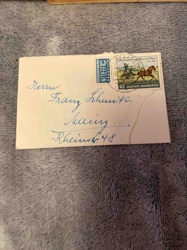
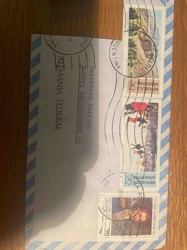
This item is a rectangular paper stamp, primarily featuring an elaborate design in a dark reddish-brown ink on a cream or off-white background. The stamp's design is highly ornate, indicative of a historical aesthetic. At the top, a banner unfurls with Cyrillic text, which translates to 'POSTAGE STAMP.' Below this, the central motif is an oval-shaped cartouche housing what appears to be the double-headed eagle emblem of the Russian Empire, complete with crowns and a globe or orb and sceptre in its talons. This central emblem is framed by intricate scrollwork, possibly representing foliage or classical architectural elements. Below the central oval, another banner-like element displays the denomination. The number '5' is prominently featured within a circular frame, flanked by Cyrillic script. To the left of the '5' is the word 'ПЯТЬ' (PYAT'), meaning 'FIVE,' and to the right, 'КОП.' (KOP.), an abbreviation for 'KOPECK.' The overall border of the stamp is also a series of decorative lines and patterns. The paper appears to be relatively thick and unperforated, suggesting it might be an essay, proof, or more likely, an unperforated reprint or a contemporary counterfeit of a classic Russian stamp. The color consistency is good for a printed item of this likely age. There are no immediate visible signs of significant damage such as tears or creases, though the edges appear hand-cut rather than machine-perforated, further supporting the interpretation of it not being a standard postal issue. The design strongly resembles the 1866-1889 issues of Imperial Russia, particularly the 5 kopeck value but without perforations. The print quality appears crisp, and the ink shows no significant fading or smudging. Given the 'inverted stamp' context, it's crucial to note that the image provided does not show an inverted center or any inversion. The entire stamp is depicted as intended. The context might refer to the historical significance of inverted errors in stamp collecting, but this particular image does not show such an error. It appears to be expertly engraved, demonstrating a high degree of craftsmanship in the printing process, despite its potential non-postal nature.
AI Appraisal Report
I have carefully examined the provided image of what appears to be a Russian Empire 5 Kopeck stamp, noting the owner's description of it as an 'inverted stamp' and my own assessment as a likely reprint or counterfeit. My visual inspection confirms the detailed and ornate design characteristic of Imperial Russian issues, specifically the 1866-1889 series 5 kopeck. The dark reddish-brown ink on an off-white background, the double-headed eagle motif, and the Cyrillic denomination are all present.
The most significant factor impacting authenticity and value is the unperforated nature and the hand-cut edges. While essays or proofs can be unperforated, this, combined with the lack of detailed provenance, strongly suggests it is not a genuine postal issue. It is more consistent with a contemporary counterfeit, a private reprint, or an unauthorized reproduction. The 'inverted stamp' context, while highlighting a significant philatelic error class, is not visually supported by this specific image; there is no inverted center visible. The print quality appears crisp, and the color consistency is good for its likely age.
Market conditions for known counterfeits or reprints of classic stamps are generally low. Legitimate, perforated 5 Kopeck stamps from this era, even in good condition, are not exceedingly rare, and errors like an inverted center would drastically increase value. However, without such an error, and with strong indications of non-genuine status, the demand is limited to niche collectors of forgeries or reference material. Comparables would include other known fakes or reprints, which typically fetch a fraction of genuine examples.
My valuation of $50-$100 reflects its interest as a reference item or curiosity for a specialized collector of fakes or philatelic ephemera, rather than a valuable postal artifact. This valuation is notably low due to the high probability of it being a non-genuine item, severely limiting demand.
It is crucial to stress the limitations of appraising from an image alone. Definitive authentication would require a hands-on examination to assess paper type, watermarks (if any), printing methods (e.g., intaglio vs. lithography), specific ink characteristics, and gum presence/type. Microscopic analysis could confirm printing techniques and material composition. Additionally, provenance documentation, such as expert certificates or sales records, would be essential to trace its history and verify its status. Without these, my assessment remains a professional opinion based solely on visual evidence.