AI Appraisal Estimate

AI-generated estimates · not official valuations

From the user

What was submitted

Photo and notes provided by the user — not generated by AI

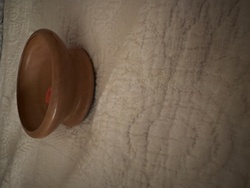
Submitted item photo
Submitted photo · June 15, 2026

User's notes

No additional notes provided.

AI analysis below

AI appraisal

AI analysis & estimate

AI-Generated · Verify before acting

Everything below is generated by AI for informational purposes only. AI can make mistakes — the AI may misidentify items or misattribute them (artist, maker, brand, designer, origin, era). This is not an official valuation and should not be used for insurance, sale, tax, estate, legal, or lending purposes — or any decision requiring a certified appraisal. It is not an authoritative claim about any person, brand, or rights holder — do not share or rely on it as a factual statement about a third party. Always consult qualified professionals before making financial decisions.

Read the full disclaimer

AI Identification

·Not independently authenticated·Verify before acting

Ancient Greek-Style Aryballos with Warrior Depiction

Ceramic Vessel

AI Estimated Value

·Not an official valuation·Verify before acting

$150-250

As of June 15, 2026

AI Item Analysis

·AI can make mistakes·Verify before acting
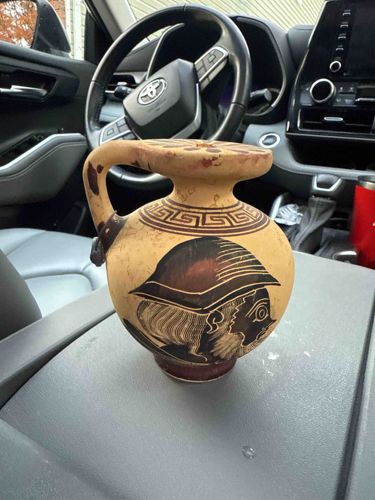
This item is an aryballos, a small spherical or globular flask used in ancient Greece for holding oil or perfume. It features a distinctive squat body with a narrow neck, a wide, flat lip, and a single strap handle connecting the neck to the shoulder. The primary material appears to be terracotta or a similar earthenware ceramic, characterized by a light yellowish-brown 'biscuit' color. The decoration is executed in a black-figure style, depicting a profile portrait of a warrior or male figure wearing a helmet, specifically on the main body of the flask. The figure exhibits detailed linework for facial features, hair, and helmet contours. Above this main depiction, encircling the shoulder of the vessel, is a continuous meander or 'Greek key' pattern in black. The lip also appears to have some decorative elements, possibly dots or geometric patterns, though they are less clear. The handle is unadorned except for its natural ceramic color, showing some reddish-brown discoloration or patina. The overall construction suggests hand-thrown pottery. Visible condition issues include areas of wear, particularly on the lip and handle, where the underlying ceramic color is more exposed, and some dark reddish-brown reddish marks which might be old residue or further patination. The black-figure decoration itself shows some slight fading or loss of pigment in places. The ceramic surface has a matte to slightly satin finish. Based on the style and decoration, this piece is likely a reproduction or a revival piece inspired by ancient Greek pottery, specifically from the Archaic or Classical periods, rather than an authentic antiquity. The craftsmanship appears competent, with consistent decorative patterns and a well-formed body, indications of a quality reproduction.
AI Appraisal Report

·AI can make mistakes·Verify before acting
I have examined the provided image of this ceramic aryballos. Based on its style, decoration, and visible condition, I assess it as a modern reproduction inspired by ancient Greek black-figure pottery, likely from the Archaic or early Classical periods. The 'biscuit' color of the ceramic, the consistency of the black-figure decoration, and the relatively uniform surface finish, despite simulated wear, point away from an authentic antiquity. The 'wear' on the lip and handle, combined with reddish-brown marks, appears more consistent with intentional aging or residue from display rather than centuries of burial and handling. While the craftsmanship is competent, with a well-formed body and consistent decorative patterns, it lacks the nuanced irregularities and patinas typically found on genuine ancient pieces. Its authenticity as an ancient artifact cannot be confirmed from images alone; an in-person examination would involve inspecting the clay body for inclusions, examining the firing process, and potentially performing thermoluminescence dating to confirm age. Additionally, provenance documentation would be crucial for establishing its history. Without these, it remains a decorative reproduction. Market conditions for such reproductions are stable, appealing to collectors of classical-style decorative arts. Comparable items, good quality reproductions of ancient Greek pottery, typically retail in the $100-300 range. Demand is generally moderate, driven by aesthetic appeal rather than historical significance or rarity. The primary impact on value here is its status as a reproduction; an authentic ancient aryballos with similar decoration would command significantly higher prices. Given its decorative quality and likely modern origin, I estimate the appraisal value to be between $150 and $250.

Get your items appraised

Instant estimates of your treasures with AI-powered appraisals

Browse More Appraisals