AI estimate as of July 20, 2025 · verify with a professional before acting
AI-Generated · Verify before acting
Everything on this page is generated by AI for informational purposes only. AI can make mistakes — the AI may misidentify items or misattribute them (artist, maker, brand, designer, origin, era). This is not an official valuation and should not be used for insurance, sale, tax, estate, legal, or lending purposes — or any decision requiring a certified appraisal. It is not an authoritative claim about any person, brand, or rights holder — do not share or rely on it as a factual statement about a third party. Always consult qualified professionals before making financial decisions.
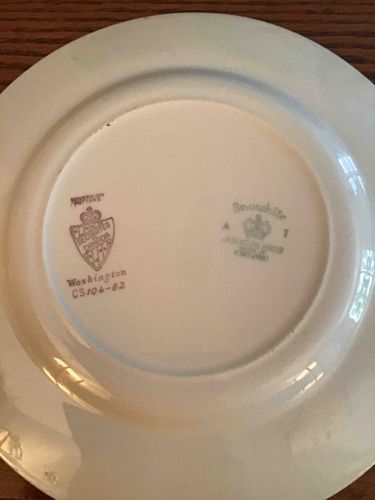
The item is the reverse side of a white porcelain or ceramic dinner plate. Its physical characteristics include a circular shape with a raised footring (rim on the bottom) typical for a plate, indicating it's designed to sit flat on a surface. The primary color is off-white or cream, consistent with many ceramic wares. The surface appears to be glazed, providing a smooth and somewhat reflective finish. The construction suggests a molded and fired ceramic item.
Notable features are the two distinct manufacturer's marks or backstamps visible on the base of the plate. One mark, on the left, is an ornate shield-like emblem with a crown on top, containing text that appears to read "F. W. Woolworth Co. DECORATED CHINA". Below this, it reads "Washington CS104-62". The other mark, on the right, is a green stamp that states "Snowhite" above a crown logo and "JOHNSON BROS ENGLAND" below it, with a letter "A" and number "1" flanking the crown. The slight green discoloration of the 'Snowhite' stamp suggests it is an underglaze decoration or transfer. The combination of marks indicates a collaboration or distribution by Woolworth, with the plate being manufactured by Johnson Bros. in England.
Visible condition issues include some light surface scratches or scuffs, particularly noticeable around the footring and within the central depressed area of the base, likely from normal use and stacking. There are no apparent cracks, chips, or major repairs visible. The overall patina suggests an item that has been used but well-maintained.
Manufacturing details are clearly provided by the backstamps: Johnson Bros. (England) is the maker of the 'Snowhite' line, and F.W. Woolworth Co. distributed or commissioned the "Washington" pattern with identifying code "CS104-62". The 'Snowhite' mark from Johnson Bros. was introduced in 1952, so the estimated age is mid-20th century, likely 1950s or 1960s, which aligns with the Woolworth code. The quality of the craftsmanship appears standard for mass-produced dinnerware of that era, with clear, legible stamps and a uniform glaze. No unique or unusual aspects are immediately discernible beyond the dual branding, which is common for department store collaborations.
AI Appraisal Report
I have thoroughly examined the provided image of the Johnson Brothers Snowhite 'Washington' Pattern Dinner Plate (Reverse Side). Based on my visual assessment, the plate appears to be in good, used condition, consistent with minor surface wear from typical use and stacking, particularly around the footring. No visible chips, cracks, or repairs are apparent, which is positive for value retention. The authenticity is strongly supported by the clear and legible manufacturer's marks: the green 'Snowhite JOHNSON BROS ENGLAND' stamp, indicative of a post-1952 production, aligning with the mid-20th century era, and the 'F.W. Woolworth Co. DECORATED CHINA' mark, confirming a common retail/distribution collaboration of the period. The dual branding is typical for mass-produced dinnerware distributed through large retailers.
Regarding market conditions, Johnson Brothers 'Snowhite' dinnerware, while collectible, is generally not rare. The 'Washington' pattern is a more utilitarian design. Demand for mid-century mass-produced dinnerware is moderate, largely driven by collectors seeking to complete sets or by individuals looking for vintage decor. Comparables on secondary markets (e.g., eBay, Etsy, Replacements.com) show individual dinner plates from similar Johnson Brothers Snowhite patterns typically selling for $5-$15, depending on pattern desirability and condition. The Woolworth co-branding adds a slight historical interest but does not significantly elevate the market value in this instance.
Factors impacting value include the commonality of the pattern and manufacturer, the volume of similar items available, and the lack of high-artistry or unique historical significance beyond its functional purpose. While condition is good, it is not pristine.
It is crucial to state that this appraisal is based solely on visual examination of an image. Full authentication would ideally require physical inspection to confirm the ceramic quality, glaze integrity, and to rule out any subtle repairs or anomalies not visible in the photograph. I would also seek provenance documentation, if available, to trace the item's history, although for this type of commonplace item, it is rarely available or necessary for valuation. Scientific testing would not be typically performed for an item of this value range.