These notes were written by the person who submitted this item. Appraiser.AI has not verified them, and the AI's identification and estimate may rely on them.
AI Estimated Value
Not an official valuation
$150-$250
AI estimate as of January 29, 2026 · verify with a professional before acting
AI-Generated · Verify before acting
Everything on this page is generated by AI for informational purposes only. AI can make mistakes — the AI may misidentify items or misattribute them (artist, maker, brand, designer, origin, era). This is not an official valuation and should not be used for insurance, sale, tax, estate, legal, or lending purposes — or any decision requiring a certified appraisal. It is not an authoritative claim about any person, brand, or rights holder — do not share or rely on it as a factual statement about a third party. Always consult qualified professionals before making financial decisions.
This analysis also relies on unverified notes provided by the user, which may be incomplete or inaccurate and could affect the result.
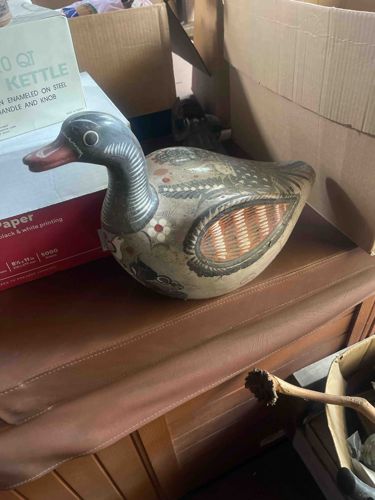
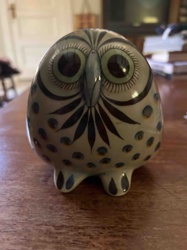
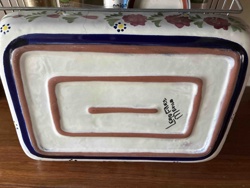
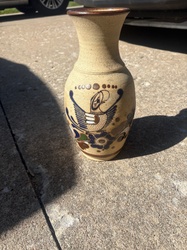
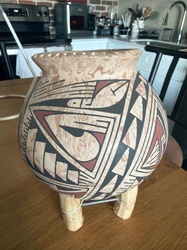
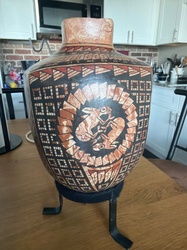
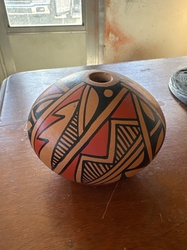
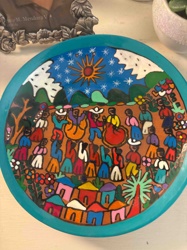
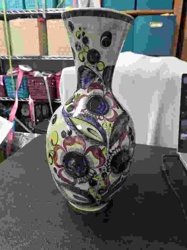
This is a large, hand-painted ceramic sculpture of a duck, executed in the traditional Tonalá style from Jalisco, Mexico. The piece is constructed from burnished earthenware (barro bruñido), featuring a smooth, semi-matte finish. Physically, the sculpture depicts a rounded, stylized waterfowl with an elongated neck and a slightly curved bill. The color palette is characteristic of the region, utilizing earthy tones including charcoal grey, cream, terracotta, and muted sage green. The decorative scheme is intricate, showcasing traditional 'flor de Tonalá' (Tonalá flower) motifs, stippled feather patterns, and a prominent fish or owl-like motif integrated into the wing area. The craftsmanship is evident in the fine line-work and symmetrical balance of the painted elements. Notable features include the white-rimmed eyes and the textured, cross-hatched pattern within the wing section. Stylistically, this piece likely dates to the late 20th century, specifically between the 1970s and 1990s. The condition appears fair to good; there is visible surface wear, particularly around the chest and beak, and significant dust accumulation suggests long-term storage. There are some minor scuffs and potential small chips along the lower edge and on the tail, consistent with handling. No clear maker's signature is visible in the photograph, though these are typically signed 'Mexico' or with the artist's name on the underside. The scale is substantial, as seen by its comparison to the neighboring 10-quart kettle box, making it a significant decorative statement piece of Mexican folk art.
AI Appraisal Report
I have examined the provided images and descriptions of this large Mexican Folk Art ceramic duck. This piece is a classic example of 'Barro Bruñido' from Tonalá, Jalisco, likely produced between 1970 and 1990. The burnished earthenware technique and traditional 'flor de Tonalá' motifs are consistent with the region's heritage. The scale and intricate stippling suggest a skilled hand, though the lack of a visible master signature (such as Jorge Wilmot or Ken Edwards) places it in the category of high-quality decorative folk art rather than a modern masterpiece. Based on the visual evidence, the condition is fair. There is significant surface abrasion on the chest and beak, which degrades the value, as the appeal of burnished pottery relies heavily on its smooth, reflective finish. Market demand for Tonalá pottery remains steady among collectors of Latin American folk art, though values for unsigned mid-century to late-century pieces are currently modest. Large-scale animal figurines fetch higher prices than small vessels, but condition issues are the primary limiting factor here. This valuation is based on current auction trends for similar avian forms of this size. Please note that this appraisal is based on photographic evidence only. A physical examination is required to confirm the presence of a maker's mark on the base and to determine if the surface wear can be professionally conserved. Direct inspection would also be necessary to rule out structural cracks or prior repairs that are not visible in the images. For definitive authentication, I would recommend checking for a 'Mexico' stamp or artist's cipher on the underside and researching any known provenance from mid-century importers.