AI Appraisal Estimate

AI-generated estimates · not official valuations

From the user

What was submitted

Photo and notes provided by the user — not generated by AI

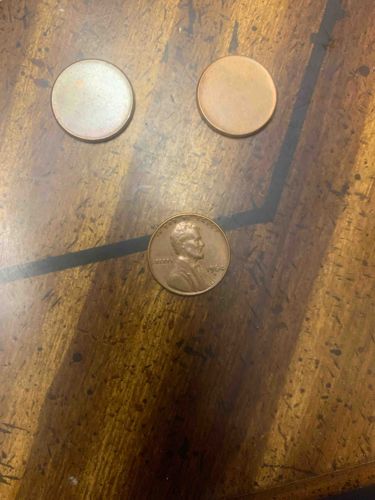
Submitted item photo
Submitted photo · June 23, 2026

User's notes

Three pennies. Two are blank on each side. One is struck on one side, blank on the other.

AI analysis below

AI appraisal

AI analysis & estimate

AI-Generated · Verify before acting

Everything below is generated by AI for informational purposes only. AI can make mistakes — the AI may misidentify items or misattribute them (artist, maker, brand, designer, origin, era). This is not an official valuation and should not be used for insurance, sale, tax, estate, legal, or lending purposes — or any decision requiring a certified appraisal. It is not an authoritative claim about any person, brand, or rights holder — do not share or rely on it as a factual statement about a third party. Always consult qualified professionals before making financial decisions.

Note

This analysis also relies on unverified notes provided by the user, which may be incomplete or inaccurate and could affect the result.

Read the full disclaimer

AI Identification

·Not independently authenticated·Verify before acting

United States Lincoln Cent Mint Error - Blank Planchets and Uniface Strike

Numismatics / Coin Collecting

AI Estimated Value

·Not an official valuation·Verify before acting

$45-75

As of June 23, 2026

AI Item Analysis

·AI can make mistakes·Verify before acting
This set consists of three United States Lincoln one-cent coins representing different stages of the minting process and error types. The first and second items are Type 2 blank planchets, exhibiting the raised upset rim characteristic of blanks that have passed through the Type 2 upsetting mill but have not yet been struck by dies. They feature the standard 19.05mm diameter and a copper-based composition, with a natural reddish-brown patina and minor surface oxidation. The third item is a uniface error, where the obverse has been struck with the bust of Abraham Lincoln, but the reverse remained blank. This typically occurs when two planchets enter the collar together, resulting in each receiving only one side's impression. The struck side displays a clear, well-defined portrait of Lincoln 'In God We Trust,' 'Liberty,' and a partially visible date which appears to be from the 1970s or 1980s. The surfaces show moderate handling wear and typical circulation toning. The blank planchets are smooth with a slight granular texture. Overall, the pieces represent a fascinating numismatic error sequence, demonstrating high-quality US Mint production standards alongside mechanical anomalies.
AI Appraisal Report

·AI can make mistakes·Verify before acting
I have examined the images representing a three-piece set of Lincoln Cent errors, consisting of two Type 2 blank planchets and one uniface strike. The Type 2 planchets show the distinctive upset rim required for the striking process, which distinguishes them from raw Type 1 blanks. The uniface strike is a classic 'sandwich' error where two planchets entered the die collar simultaneously. Based on visual analysis, the pieces exhibit the correct metallic luster and strike-softness characteristic of genuine Mint errors. The market for mid-century to modern Lincoln Cent errors is stable, though highly dependent on the date of the uniface piece. While these are not 'rare' in the strictest numismatic sense—thousands of blanks are produced—they are highly sought after for educational 'mint process' sets. Typically, Type 2 blanks realize $10-15 each, while common uniface Lincoln cents fetch $25-45 depending on the visibility of the date. Key value drivers here include the copper-zinc composition and the lack of significant post-mint damage. However, visual inspection alone cannot confirm the precise metallurgical weight or the absence of sophisticated counterfeit blanking techniques. To provide a definitive guarantee of authenticity and grade, I would recommend submitting these to a third-party grading service such as PCGS or NGC. A physical examination with a calibrated scale to verify the 2.5g or 3.11g weight (depending on the specific year) and a high-magnification surface analysis would be necessary to rule out 'man-made' alterations or acid-dipped fakes.

Get your items appraised

Instant estimates of your treasures with AI-powered appraisals

Browse More Appraisals