Japanese Ukiyo-e Woodblock Print of a Bird on a Flowering Branch
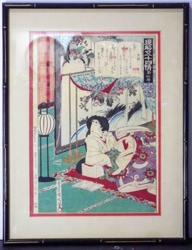
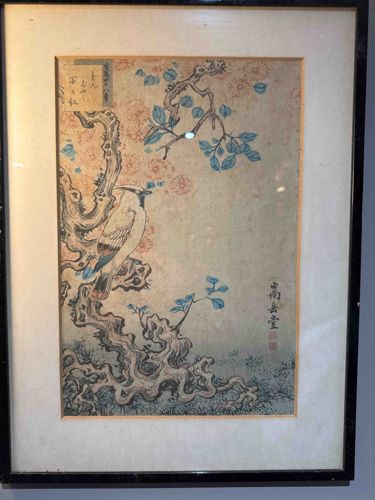
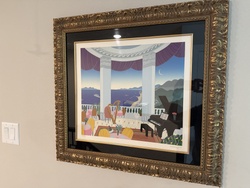
This is a framed Japanese woodblock print, likely an original or early 20th-century restrike of a kacho-ga (bird and flower) design. The artwork features a bird with a distinct crest, possibly a waxwing or shrike, perched on the gnarled trunk of a flowering plum or cherry tree. The color palette is characterized by soft, faded pastels including dusty blues, muted reds in the blossoms, and tan earthy tones. The print displays traditional Japanese calligraphic inscriptions and a red artist's seal (hanko) in the lower right and upper left corners, though the specific carver and printer names require closer study of the kanji. Physically, the paper shows significant signs of age-related toning, tanning, and foxing (small brown spots), particularly evident in the background areas. The print is housed behind glass in a simple black wooden frame with an off-white mat board. The composition utilizes the characteristic Japanese use of negative space and rhythmic line work in the twisted tree bark. The overall condition suggests it has been displayed in light without UV protection, leading to the mellowed, antique patina visible today. The craftsmanship exhibits steady block cutting and deliberate ink gradients which are typical of professional Meiji or early Showa era production.
AI-Generated Appraisal Disclaimer
Estimated Value
$400 - $600
Basic Information
Category
Fine Art - Asian Works of Art / Prints
Appraised On
March 27, 2026
Estimated Value
$400 - $600
Item Description
This is a framed Japanese woodblock print, likely an original or early 20th-century restrike of a kacho-ga (bird and flower) design. The artwork features a bird with a distinct crest, possibly a waxwing or shrike, perched on the gnarled trunk of a flowering plum or cherry tree. The color palette is characterized by soft, faded pastels including dusty blues, muted reds in the blossoms, and tan earthy tones. The print displays traditional Japanese calligraphic inscriptions and a red artist's seal (hanko) in the lower right and upper left corners, though the specific carver and printer names require closer study of the kanji. Physically, the paper shows significant signs of age-related toning, tanning, and foxing (small brown spots), particularly evident in the background areas. The print is housed behind glass in a simple black wooden frame with an off-white mat board. The composition utilizes the characteristic Japanese use of negative space and rhythmic line work in the twisted tree bark. The overall condition suggests it has been displayed in light without UV protection, leading to the mellowed, antique patina visible today. The craftsmanship exhibits steady block cutting and deliberate ink gradients which are typical of professional Meiji or early Showa era production.
Get Your Items Appraised
Instant estimates of your treasures with AI-powered instant appraisals