AI estimate as of October 27, 2025 · verify with a professional before acting
AI-Generated · Verify before acting
Everything on this page is generated by AI for informational purposes only. AI can make mistakes — the AI may misidentify items or misattribute them (artist, maker, brand, designer, origin, era). This is not an official valuation and should not be used for insurance, sale, tax, estate, legal, or lending purposes — or any decision requiring a certified appraisal. It is not an authoritative claim about any person, brand, or rights holder — do not share or rely on it as a factual statement about a third party. Always consult qualified professionals before making financial decisions.
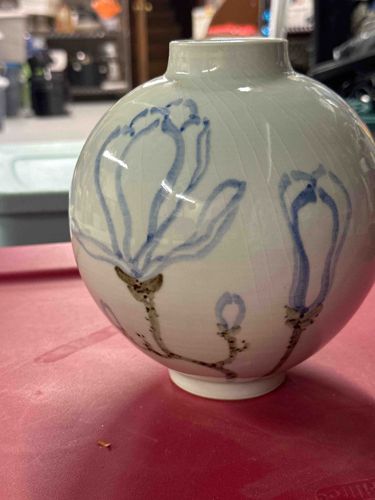
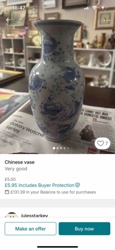
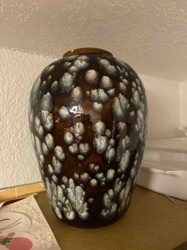
This appears to be a spherical ceramic vase, approximately 6-8 inches in diameter, characterized by its rounded body and a narrow, short neck that transitions smoothly into the shoulders. The primary material is ceramic, likely porcelain or stoneware, covered with a pale, possibly celadon-toned glaze that exhibits a fine crackle pattern across its surface, suggesting either an intentional artistic effect or evidence of aging. The crackle is subtle but visible, particularly in the cropped images. The decoration features stylized floral motifs, rendered in underglaze blue and a darker brown or sepia tone. The blue is used to outline and fill the petals of what appear to be blossoming flowers, possibly magnolias or lotus flowers, depicted with soft, fluid brushstrokes. The stems and some internal details of the flowers are executed in the brown color, also with a hand-painted, somewhat abstract style. There are at least three prominent floral clusters visible. The vase has a small, unglazed or minimally glazed foot rim, which provides stability. The craftsmanship suggests it is hand-thrown or hand-finished, given the organic nature of the brushwork and the subtle imperfections inherent in ceramic art. No prominent maker's marks or signatures are visible in the provided images. The style hints at an East Asian influence, possibly Chinese, Japanese, or Korean, particularly given the celadon-like glaze and underglaze painting technique. The overall condition appears good; no significant chips, cracks, or repairs are immediately apparent, though closer inspection would be required to confirm. The aesthetic points to a decorative art piece, possibly from the mid-20th century to contemporary, emphasizing traditional ceramic techniques with a modern or minimalist interpretation of floral subjects.
AI Appraisal Report
Based on my visual examination of the provided images, this Celadon Glazed Spherical Vase with Underglaze Blue and Brown Floral Decoration appears to be in very good condition with no immediately visible chips, cracks, or repairs. The subtle crackle in the glaze, if intentional, adds to its aesthetic appeal. The hand-painted floral motifs in underglaze blue and brown suggest an East Asian influence, possibly Chinese, Japanese, or Korean, with a traditional yet somewhat abstract style. Without direct physical inspection, I cannot definitively determine the exact age or origin, but the craftsmanship points to a decorative art piece.
Market conditions for contemporary ceramic art with East Asian stylistic influences are moderate. Comparables typically include studio pottery or mass-produced decorative items from the mid-20th century onwards. The lack of a visible maker's mark significantly impacts its value, as identification of a renowned artist or studio would command a higher price. Demand for such pieces is generally driven by decorative appeal rather than historical significance, unless provenance points to a specific artist or period. The overall good condition and appealing aesthetic contribute positively to its value.
Limitations in authenticity verification are significant based on images alone. A physical examination is crucial to assess the true nature of the crackle (intentional vs. age-related crazing), the precise type of ceramic body, and the quality of the glaze and underglaze painting in detail. In-person inspection would also allow for examination of the foot rim for any faint marks or signs of age not visible in photographs. Provenance documentation, such as purchase receipts or expert opinions, would be essential for fuller authentication and accurate dating, especially to differentiate between a truly antique piece and a more contemporary reproduction or homage.