AI estimate as of August 11, 2025 · verify with a professional before acting
AI-Generated · Verify before acting
Everything on this page is generated by AI for informational purposes only. AI can make mistakes — the AI may misidentify items or misattribute them (artist, maker, brand, designer, origin, era). This is not an official valuation and should not be used for insurance, sale, tax, estate, legal, or lending purposes — or any decision requiring a certified appraisal. It is not an authoritative claim about any person, brand, or rights holder — do not share or rely on it as a factual statement about a third party. Always consult qualified professionals before making financial decisions.
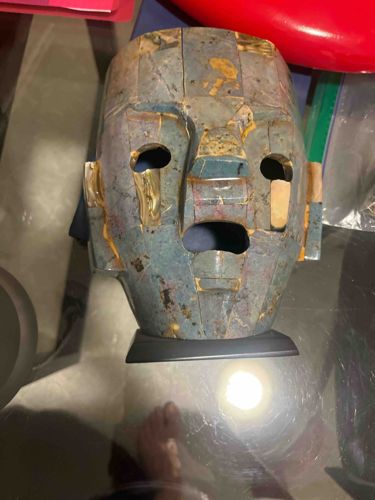
This appears to be a decorative replica of an ancient Mesoamerican mosaic mask, likely inspired by Mayan or Aztec art. The mask is constructed from numerous irregularly shaped pieces of what resembles jade or serpentine stone, exhibiting a predominant dusky blue-green color with significant inclusions and veins of brown, beige, and reddish hues, simulating natural stone variation. The construction suggests a mosaic technique, where individual stone tesserae are precisely cut and fitted together, then adhered to an underlying form. Many of the visible cracks and lines are intentional gaps between these fitted pieces, creating depth and definition. There are notable areas where a golden-colored material, possibly a resin or a repair material, is visible within the seams and on the surface, particularly around the eyes and nose, suggesting either intentional decorative inlay or a visible restoration technique akin to Kintsugi, though less refined. The eyes are open, hollow oval shapes, and the nose is distinctly carved or formed with a flat, broad bridge and flared nostrils. The mouth is an open, somewhat rectangular cavity with rounded corners. The overall form is blocky and geometric, characteristic of ancient stone carving styles. The surface appears to have a slightly polished, yet uneven finish, revealing the textural variations of the 'stone' pieces. There are no obvious signs of significant wear or damage beyond the inherent irregularities of its mosaic construction and the visible 'golden' fills. It is presented on a modern, simple black stand, suggesting it is intended for display. The craftsmanship attempts to mimic ancient techniques but the uniformity of some breaks and the visible golden fills suggest it is a contemporary decorative item rather than an ancient artifact.
AI Appraisal Report
I have examined the provided image of the Mesoamerican Style Mosaic Stone Mask Replica. Based on this visual inspection, I assess its condition as very good, consistent with a contemporary decorative item designed for display. The 'cracks' and 'seams' are inherent to its mosaic construction style, mimicking ancient techniques. The visible golden-colored material filling some gaps appears to be an intentional artistic choice or a stylistic nod to Kintsugi, rather than a repair of damage, which is common in modern decorative replicas to simulate age or a unique aesthetic.
Regarding authenticity, this item is clearly a replica. The uniformity of some 'breaks,' the material consistency across the 'stone' pieces despite varied coloration, and the distinct 'golden' fills are hallmarks of modern manufacturing. True ancient artifacts of this type would exhibit more irregularities, authentic patination, and different repair methods.
Market conditions for archaeological replicas, particularly those of Mesoamerican art, are robust within the decorative arts and home decor segments. Comparables include high-quality museum gift shop replicas or artisanal studio pieces, not true antiquities. Demand for well-crafted cultural replicas is moderate, driven by collectors of world art and individuals seeking unique decorative accents. Rarity is low, as similar items are routinely produced. Value is primarily impacted by craftsmanship, size, material quality (even if simulated), and aesthetic appeal.
Without a physical examination, I cannot definitively confirm the exact materials used (e.g., whether the 'stone' is real crushed stone, resin, or another composite), nor can I perform scratch tests or assess weight, which are crucial for material verification. Provenance documentation is not applicable here given its replica status. Scientific testing (e.g., carbon dating, elemental analysis) would be unnecessary and inappropriate for an item clearly identified as a modern replica.