Carved Nephrite Jade Dragon Pendent in Archaic Style
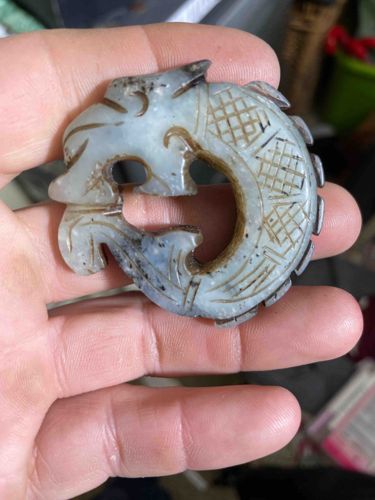
This item is a hand-carved pendant fashioned in the shape of a coiled dragon, likely intended to replicate an archaic Chinese 'zhulong' or pig-dragon form. The piece is crafted from a celadon-toned stone, likely nephrite jade, featuring a cloudy, semi-translucent appearance with significant intentional or natural inclusions. The coloration is a pale grayish-green with dark spotting and areas of brownish surface staining, often referred to as 'russet' in jade contexts, which may be naturally occuring or chemically induced to simulate age. The construction involves flat-plane carving with linear incised patterns, including a cross-hatched geometric design on the body and stylized scrollwork defining the head and facial features. The exterior circumference is notched with serrated protrusions. The overall condition shows rough surface edges and some particulate build-up within the incised lines, though no large fractures are immediately visible. While the style references the Hongshan culture or Han Dynasty, the crispness of the lines and the specific surface aging suggest it is a 20th-century or modern decorative reproduction rather than an authentic ancient artifact. The level of craftsmanship indicates a mass-market production rather than a master lapidary work, as seen in the slightly irregular spacing of the incised patterns and the shallow depth of the carving.

AI-Generated Appraisal Disclaimer
Estimated Value
$40 - $80
Basic Information
Category
Asian Antiques & Collectibles
Appraised On
December 23, 2025
Estimated Value
$40 - $80
Item Description
This item is a hand-carved pendant fashioned in the shape of a coiled dragon, likely intended to replicate an archaic Chinese 'zhulong' or pig-dragon form. The piece is crafted from a celadon-toned stone, likely nephrite jade, featuring a cloudy, semi-translucent appearance with significant intentional or natural inclusions. The coloration is a pale grayish-green with dark spotting and areas of brownish surface staining, often referred to as 'russet' in jade contexts, which may be naturally occuring or chemically induced to simulate age. The construction involves flat-plane carving with linear incised patterns, including a cross-hatched geometric design on the body and stylized scrollwork defining the head and facial features. The exterior circumference is notched with serrated protrusions. The overall condition shows rough surface edges and some particulate build-up within the incised lines, though no large fractures are immediately visible. While the style references the Hongshan culture or Han Dynasty, the crispness of the lines and the specific surface aging suggest it is a 20th-century or modern decorative reproduction rather than an authentic ancient artifact. The level of craftsmanship indicates a mass-market production rather than a master lapidary work, as seen in the slightly irregular spacing of the incised patterns and the shallow depth of the carving.

Related Tags
Get Your Items Appraised
Instant estimates of your treasures with AI-powered instant appraisals