American Brilliant Period Cut Glass Open Sugar Bowl
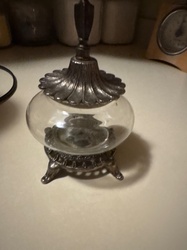
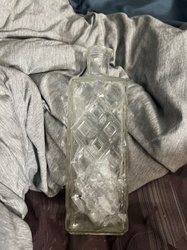
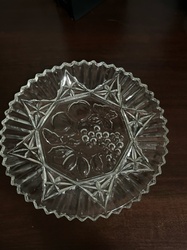
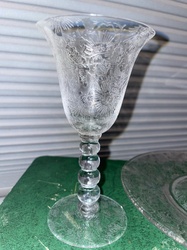
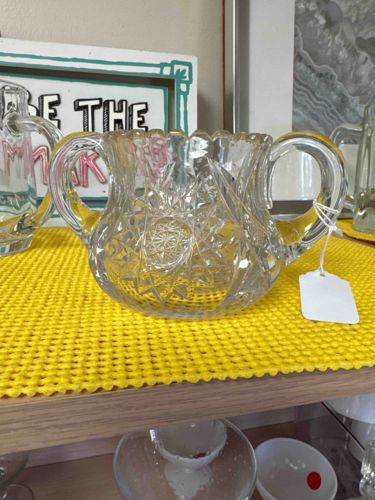
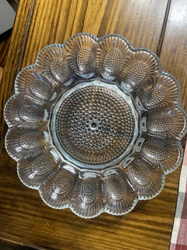
This is a fine example of American Brilliant Period (ABP) cut glass, specifically an open sugar bowl featuring a classic double-handled design. The clear lead glass body is intricately decorated with a deep, hand-cut geometric pattern, prominently showcasing a large hobstar motif at the center, flanked by miter cuts and cross-hatched diamonds. The rim is elegantly finished with a scalloped, saw-tooth edge, while the two applied glass handles are curved and polished for a comfortable grip. Measuring approximately 3 to 4 inches in height, the piece exhibits the high refractive index and heavy weight characteristic of lead crystal from the late 19th to early 20th century (circa 1880-1915). Close inspection reveals high-quality craftsmanship with sharp, well-defined miters and a brilliant polish. There are no readily visible chips or cracks on the main body or handles, though minor 'flea bites' or shelf wear on the base and saw-tooth rim are common for glassware of this age. No specific maker's marks are immediately visible, but the pattern is indicative of major manufacturers of the era such as Libbey, Hawkes, or Dorflinger. The glass remains remarkably clear without significant clouding or 'sick glass' syndrome.
AI-Generated Appraisal Disclaimer
Estimated Value
$125 - $175
Basic Information
Category
Antique Glassware
Appraised On
January 16, 2026
Estimated Value
$125 - $175
Item Description
This is a fine example of American Brilliant Period (ABP) cut glass, specifically an open sugar bowl featuring a classic double-handled design. The clear lead glass body is intricately decorated with a deep, hand-cut geometric pattern, prominently showcasing a large hobstar motif at the center, flanked by miter cuts and cross-hatched diamonds. The rim is elegantly finished with a scalloped, saw-tooth edge, while the two applied glass handles are curved and polished for a comfortable grip. Measuring approximately 3 to 4 inches in height, the piece exhibits the high refractive index and heavy weight characteristic of lead crystal from the late 19th to early 20th century (circa 1880-1915). Close inspection reveals high-quality craftsmanship with sharp, well-defined miters and a brilliant polish. There are no readily visible chips or cracks on the main body or handles, though minor 'flea bites' or shelf wear on the base and saw-tooth rim are common for glassware of this age. No specific maker's marks are immediately visible, but the pattern is indicative of major manufacturers of the era such as Libbey, Hawkes, or Dorflinger. The glass remains remarkably clear without significant clouding or 'sick glass' syndrome.
Get Your Items Appraised
Instant estimates of your treasures with AI-powered instant appraisals