These notes were written by the person who submitted this item. Appraiser.AI has not verified them, and the AI's identification and estimate may rely on them.
AI Estimated Value
Not an official valuation
$400 - $600
AI estimate as of September 18, 2025 · verify with a professional before acting
AI-Generated · Verify before acting
Everything on this page is generated by AI for informational purposes only. AI can make mistakes — the AI may misidentify items or misattribute them (artist, maker, brand, designer, origin, era). This is not an official valuation and should not be used for insurance, sale, tax, estate, legal, or lending purposes — or any decision requiring a certified appraisal. It is not an authoritative claim about any person, brand, or rights holder — do not share or rely on it as a factual statement about a third party. Always consult qualified professionals before making financial decisions.
This analysis also relies on unverified notes provided by the user, which may be incomplete or inaccurate and could affect the result.
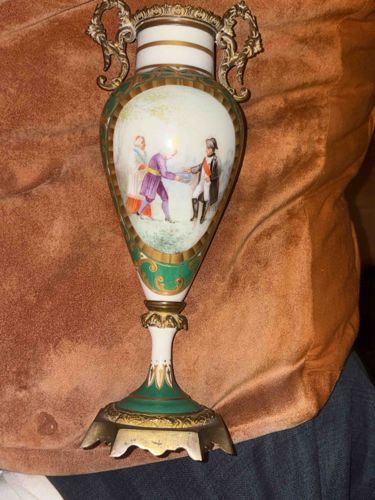
This exquisite item is an ornamental urn or vase, meticulously crafted from porcelain and adorned with brass elements. Its overall form is elongated and elegant, tapering from a wider upper body to a slender stem and then flaring out to a sturdy base. The primary colors are a pristine white and a rich emerald green, accented throughout with gold detailing. The central porcelain body features a large, oval cartouche on its front, painted with a figural scene depicting three individuals, possibly in 18th or early 19th-century attire. One figure, dressed in purple, appears to be exchanging something with another figure in a dark jacket and white breeches, possibly a military or aristocratic gentleman, while a third figure observes in the background. The painting style is delicate and employs pastel tones, characteristic of romantic or rococo influences. The upper rim of the vase is encircled by a white band with thin gold lines, transitioning into a section of ornate, openwork brass handles with a distressed, aged patina that flank the sides. Below the figural scene, the porcelain is painted in the deep emerald green with elaborate gilded scrollwork or floral motifs. This pattern is mirrored on the fluted, pedestal-style stem and the lower, flared base of the porcelain. The entire porcelain structure is mounted on a substantial, squared brass plinth with decorative, scrolled feet, also exhibiting a consistent aged patina. The visible condition suggests some wear consistent with age, particularly on the brass elements which show darkening and possibly some verdigris in recesses. There are no obvious chips or cracks visible on the porcelain from the image, but a thorough inspection would be needed. The bottom is noted to have a 'Henry insignia,' which suggests a manufacturer's mark, potentially indicating a European origin, possibly French or English, given the style. This piece likely dates from the late 19th to early 20th century, reflecting revivalist styles of earlier periods. The craftsmanship is high, with detailed painting and well-executed metalwork.
AI Appraisal Report
Upon visual examination of this porcelain and brass figural urn, I assess it to be a high-quality decorative piece, likely produced in the late 19th or early 20th century. The style is a revival of 18th-century French aesthetics, specifically Sèvres or a similar Continental factory, combining rococo and neoclassical elements. The central cartouche with its romantic figural scene is delicately painted, and the emerald green ground with gilt scrollwork is well-executed. The gilt-bronze (or brass) mounts, including the ornate handles and squared base, are consistent with this period's production methods and show an aged patina.
The condition appears good from the images provided, with no visible major cracks or chips in the porcelain. The metalwork shows age-appropriate wear and darkening, which is expected and does not significantly detract from the value. The stated 'Henry insignia' is a crucial factor. Without a clear image of the mark, it is difficult to attribute it to a specific maker, such as the numerous Henry or Henri potters in France. The value is significantly impacted by the manufacturer; a piece from a renowned Sèvres or Parisian workshop would command a much higher price than one from a lesser-known factory.
Current market conditions for this type of decorative urn are stable, though revivalist pieces are generally more accessible than their 18th-century counterparts. Comparable late 19th-century European porcelain urns of this size and quality typically sell in the $400 to $600 range at auction. Rarity is moderate; while well-made, this style was popular and widely produced.
It is critical to note that this appraisal is based on images alone. For full authentication and a definitive valuation, I would require in-person examination to assess for repairs under UV light, verify the quality of the gilding and painting, and most importantly, physically inspect and research the 'Henry insignia' to confirm its origin and period. Provenance documentation would also be highly beneficial.