AI Appraisal Estimate

AI-generated estimates · not official valuations

From the user

What was submitted

Photo and notes provided by the user — not generated by AI

Submitted item photo
Submitted photo · June 3, 2026

User's notes

No additional notes provided.

AI analysis below

AI appraisal

AI analysis & estimate

AI-Generated · Verify before acting

Everything below is generated by AI for informational purposes only. AI can make mistakes — the AI may misidentify items or misattribute them (artist, maker, brand, designer, origin, era). This is not an official valuation and should not be used for insurance, sale, tax, estate, legal, or lending purposes — or any decision requiring a certified appraisal. It is not an authoritative claim about any person, brand, or rights holder — do not share or rely on it as a factual statement about a third party. Always consult qualified professionals before making financial decisions.

Read the full disclaimer

AI Identification

·Not independently authenticated·Verify before acting

Mid-Century Seascape Painting of Junk Ships

Fine Art - Paintings

AI Estimated Value

·Not an official valuation·Verify before acting

$50 - $150

As of June 3, 2026

AI Item Analysis

·AI can make mistakes·Verify before acting
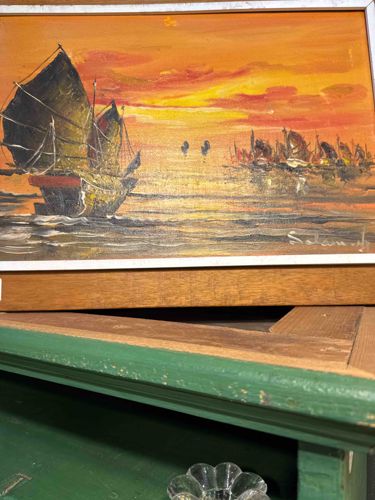
This is an original oil or acrylic painting on canvas, likely dating from the mid-to-late 20th century. The artwork depicts a traditional Chinese junk ship in the foreground navigating calm waters during a vibrant sunset or sunrise. In the background, a silhouette of a maritime village or a fleet of similar vessels is visible. The color palette is dominated by warm earthen tones, including deep oranges, yellows, and ochres, contrasted by dark browns and blacks used to define the ships' hulls and sails. The painting employs a heavy impasto technique, particularly in the lower thirds, where thick applications of white and grey paint create the texture of cresting water. A white border, possibly a liner or part of the canvas treatment, frames the central image, which is then housed in a simple wooden frame. A signature appears in the lower right corner, transcribed as 'Salim' or similar, suggesting a Southeast Asian provenance, common for this style of decorative maritime art. The condition appears fair, with visible aging to the frame and minor surface dust, though no significant craquelure or paint loss is immediately apparent from the image. The style is characteristic of mid-century 'souvenir' or decorator art often produced for international markets.


AI Appraisal Report

·AI can make mistakes·Verify before acting
I have examined the digital images of this mid-century seascape, and in my professional opinion, it represents a classic example of Southeast Asian decorative export art, likely produced in the 1960s or 70s. The painting, featuring a Chinese junk ship against a warm, impasto-heavy sunset, is signed 'Salim' in the lower right. This signature is quite common in this genre; rather than denoting a single listed master, it is frequently associated with studio artists in regions like Indonesia, Hong Kong, or Singapore producing works for the tourist and export market. Visually, the condition appears fair for its age. The heavy impasto technique used for the waves adds nice texture, but the canvas shows signs of darkening dirt accumulation typical of items that have been displayed without glass for decades. The frame is utilitarian and appears to have age-related wear. The market for this specific type of 'Junk Ship' art is saturated. While they are nostalgic and decorative, they do not command high prices unless the artist has a specific, verifiable auction record (which this 'Salim' generally does not in the high-end tier). They are predominantly sold in antique malls and estate sales rather than fine art galleries. It is important to note that without physically handling the piece, I cannot verify the specific binding medium (oil vs. acrylic) or inspect the canvas verso for further provenance marks or stamps that might pinpoint the retailer. However, given the stylistic evidence, it is almost certainly a commercial decorative piece. The value lies primarily in its aesthetic appeal and vintage charm rather than investment-grade fine art status.

Get your items appraised

Instant estimates of your treasures with AI-powered appraisals

Browse More Appraisals