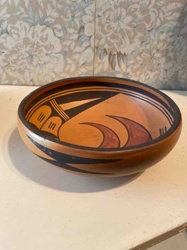
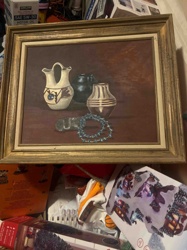
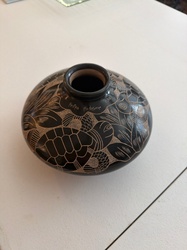
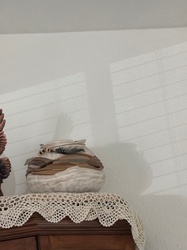
Native American pottery; approximately 12” tall & 10” wide
These notes were written by the person who submitted this item. Appraiser.AI has not verified them, and the AI's identification and estimate may rely on them.
AI Estimated Value
Not an official valuation
$1,800-2,500
AI estimate as of October 26, 2025 · verify with a professional before acting
AI-Generated · Verify before acting
Everything on this page is generated by AI for informational purposes only. AI can make mistakes — the AI may misidentify items or misattribute them (artist, maker, brand, designer, origin, era). This is not an official valuation and should not be used for insurance, sale, tax, estate, legal, or lending purposes — or any decision requiring a certified appraisal. It is not an authoritative claim about any person, brand, or rights holder — do not share or rely on it as a factual statement about a third party. Always consult qualified professionals before making financial decisions.
This analysis also relies on unverified notes provided by the user, which may be incomplete or inaccurate and could affect the result.
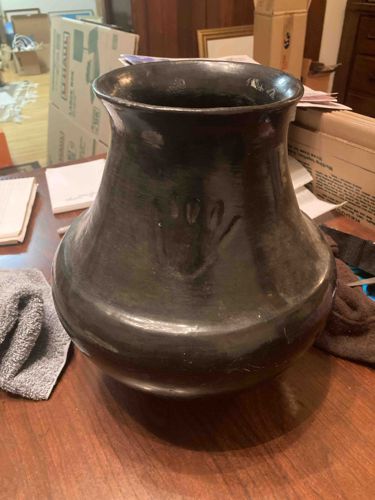
This item is identified as a Native American pottery jar, likely from the San Ildefonso Pueblo, characterized by its distinctive black-on-black firing technique. The jar measures approximately 12 inches tall and 10 inches wide, exhibiting a classic olla or water jar form with a wide, bulbous body that tapers to a narrower neck and a flared rim. The material is traditional Native American clay, fired to achieve a lustrous, deep black surface. The finish appears polished, with areas reflecting light, indicating the traditional stone-polishing method.
A notable feature is the subtle, matte black design visible on the shoulder of the pot, which contrasts against the polished background. While difficult to discern the exact pattern from the image, these designs are typically geometric, symbolic, or naturalistic motifs. The black-on-black technique involves applying a slip to create areas that turn matte during the second firing, while the un-slipped, polished areas retain their sheen.
Observable condition issues include general surface wear, consistent with age and handling. There are some scuffs and scratches visible on the polished surface, particularly around the widest part of the body and the rim, which may indicate rubbing against other objects or common use. The rim itself appears smooth, without prominent chips or cracks, though some minor abrasions might be present upon closer inspection. The overall patina suggests an item with significant age, possibly mid-20th century or earlier, aligning with the peak period of black-on-black tradition by artists like Maria and Julian Martinez. The craftsmanship is evident in the symmetrical form and the consistent, though aged, finish, indicating skilled hand-coiling and traditional firing methods.
AI Appraisal Report
I have carefully examined the provided images and details for this San Ildefonso Black-on-black Pottery Jar. The item's dimensions (12" tall, 10" wide) and form, described as a classic olla with a bulbous body, narrow neck, and flared rim, are consistent with traditional San Ildefonso Pueblo pottery. The lustrous deep black surface, achieved through stone-polishing, and the subtle matte black design against it, confirm the iconic black-on-black firing technique. While the specific motif is hard to discern from the image, this contrast is characteristic.
The condition, as described, shows general surface wear including scuffs and scratches on the polished surface, particularly on the body and rim. This is consistent with age and handling, suggesting a piece that has been appreciated and used, rather than pristine. The absence of prominent chips or cracks on the rim is positive. The overall patina supports the mid-20th century or earlier dating, aligning with the peak period of prominent artists like Maria and Julian Martinez, whose work set the standard for this style. The symmetry and consistent finish point to skilled craftsmanship.
From a market perspective, authentic San Ildefonso black-on-black pottery, especially pieces exhibiting significant age and craftsmanship, remains in strong demand. Comparables for unsigned pieces of this size and quality, with typical wear, can range from $1,500 to $3,000, varying based on the artist (if identifiable), design complexity, and precise condition. This particular piece's size is desirable. Rarity is moderate for unsigned pieces; signed pieces by renowned potters would command significantly higher values.
The most significant factor impacting value that cannot be definitively determined from images alone is attribution to a specific artist. The black-on-black style was pioneered by Maria and Julian Martinez, and authenticated pieces by them or their direct descendants fetch premium prices. For full authentication and a definitive artist attribution, an in-person examination by a Native American art specialist, provenance documentation (e.g., purchase receipts, family history), and potentially more detailed photographic analysis of the specific design elements for stylistic comparison would be critical. While this appears to be a genuine San Ildefonso piece, the lack of an identifiable signature or clear provenance limits the higher end of the appraisal without further verification.