AI estimate as of August 5, 2025 · verify with a professional before acting
AI-Generated · Verify before acting
Everything on this page is generated by AI for informational purposes only. AI can make mistakes — the AI may misidentify items or misattribute them (artist, maker, brand, designer, origin, era). This is not an official valuation and should not be used for insurance, sale, tax, estate, legal, or lending purposes — or any decision requiring a certified appraisal. It is not an authoritative claim about any person, brand, or rights holder — do not share or rely on it as a factual statement about a third party. Always consult qualified professionals before making financial decisions.
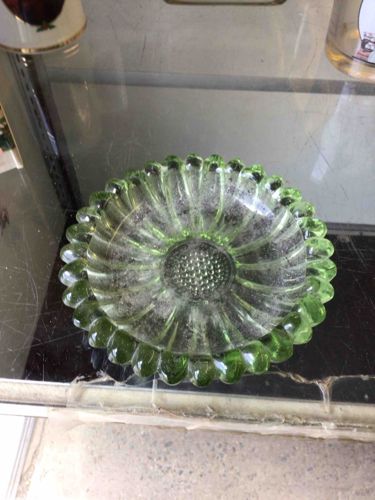
This item is a circular, shallow dish-like object likely made of pressed glass, exhibiting a distinct light green or uranium glass coloring that suggests it might fluoresce under UV light, a common characteristic of glassware from the early-to-mid 20th century. Its overall form strongly resembles a sunflower or daisy, with a central raised, textured area composed of numerous small, uniform bumps or dots, mimicking the anthers or seeds of a flower. Radiating outwards from this center are sculpted, petal-like segments that form the body of the dish, culminating in a scalloped or fluted rim, giving it a three-dimensional floral appearance. The underside also appears to follow the contours of the petals, adding to the structural integrity and aesthetic.
The glass itself appears somewhat thick, indicative of pressed glass manufacturing. There are significant visible condition issues: the surface is extensively covered in what appears to be a thick layer of dust, dirt, or possibly mold/mildew, especially concentrated in the central textured area and accumulating in the grooves of the 'petals'. This obscuring layer prevents a clear assessment of individual scratches, chips, or manufacturing flaws, but suggests long-term storage in a dusty or humid environment without cleaning. No specific maker's marks or signatures are discernible from the image due to the angle and lack of clarity. Given its material, color, and design, it is likely a vintage piece, possibly from the Art Deco or Mid-Century Modern period (1920s-1960s), commonly used as an ashtray, candy dish, or general decorative trinket dish. The quality of craftsmanship appears good for pressed glass, with a clear, defined pattern, but its current condition significantly detracts from its immediate visual appeal and potential value without thorough cleaning and examination.
AI Appraisal Report
Upon examining the provided image of the green pressed glass dish, I can confirm its likely vintage origin, consistent with early-to-mid 20th-century pressed glass. The distinct light green hue suggests it is uranium or 'Vaseline' glass, which would fluoresce under UV light. Authenticity as period pressed glass is probable based on the visual characteristics of the pattern, thickness, and color. However, without in-person inspection and a UV light test, I cannot definitively confirm the presence of uranium or rule out more contemporary reproductions, although the style points strongly to vintage. Provenance documentation would further solidify its history.
The most significant factor impacting its current visual appeal and immediate market value is its condition. The extensive layer of dust, dirt, or possible biological growth obscures the surface, preventing a thorough assessment for chips, cracks, or significant manufacturing flaws. This level of grime suggests lengthy, improper storage. While cleaning is likely to significantly improve its appearance, any underlying damage or persistent hazing would affect its ultimate worth.
Market conditions for vintage pressed glass, particularly 'Vaseline' or 'Uranium' glass, are generally stable, with a modest but consistent demand from collectors of specific glass types, decorative arts, or those seeking unique vintage home decor. Items of this nature are not exceedingly rare, especially common patterns like floral or 'sunflower' designs. Comparables typically sell based on condition, color desirability, and pattern clarity. Given its current obscured state, I'd consider it fair to medium demand.
To provide a full and accurate appraisal, I would need a physical inspection to assess the glass clarity, identify any hidden damage after thorough cleaning, and conduct a UV light test for uranium content. Without this, my valuation remains an estimate based on photographic evidence.