AI Appraisal Estimate

AI-generated estimates · not official valuations

From the user

What was submitted

Photo and notes provided by the user — not generated by AI

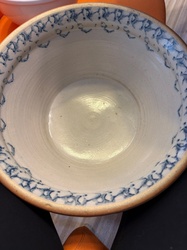
Submitted item photo
Submitted photo · June 22, 2026

User's notes

No additional notes provided.

AI analysis below

AI appraisal

AI analysis & estimate

AI-Generated · Verify before acting

Everything below is generated by AI for informational purposes only. AI can make mistakes — the AI may misidentify items or misattribute them (artist, maker, brand, designer, origin, era). This is not an official valuation and should not be used for insurance, sale, tax, estate, legal, or lending purposes — or any decision requiring a certified appraisal. It is not an authoritative claim about any person, brand, or rights holder — do not share or rely on it as a factual statement about a third party. Always consult qualified professionals before making financial decisions.

Read the full disclaimer

AI Identification

·Not independently authenticated·Verify before acting

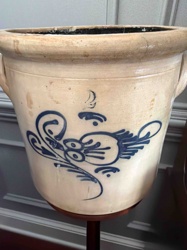
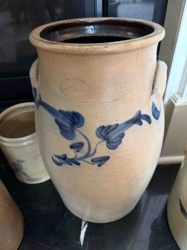
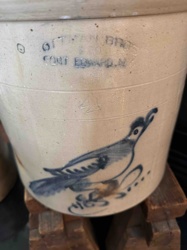
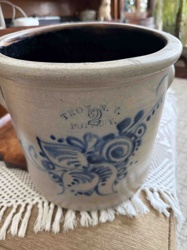
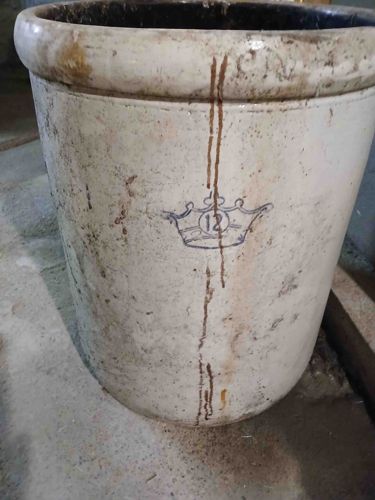
12-Gallon Robinson Ransbottom Blue Crown Stoneware Crock

Antique American Stoneware

AI Estimated Value

·Not an official valuation·Verify before acting

$175.00 - $250.00

As of June 22, 2026

AI Item Analysis

·AI can make mistakes·Verify before acting
This is a large-scale utilitarian stoneware crock, likely a 12-gallon capacity vessel based on the numerical marking. The piece is constructed from heavy, thick-walled salt-glazed clay with a characteristic cylindrical form and a prominent rolled rim at the top. The exterior features an off-white or light grey glaze with a visible cobalt blue 'Crown' stencil mark located centrally on the side, enclosing the number '12'. This specific marking is highly characteristic of the Robinson Ransbottom Pottery Co. of Roseville, Ohio, a prominent American manufacturer active throughout the early 20th century. Physically, the item shows significant signs of age and use, which contribute to its rustic patina. There are notable vertical brown iron-oxide or liquid stains running down the face of the crock, possibly from storage conditions or previous contents. The surface exhibits various pitted spots, 'turkey tracks', and minor surface abrasions consistent with hand-turned industrial pottery. The interior appears to have a dark Albany-type slip glaze, which was common for waterproofing these storage containers. While no large structural cracks are immediately visible in this view, the rim shows minor chipping and general wear. This piece likely dates from the 1920s to the 1940s and represents a classic example of American salt-glazed kitchenware designed for preserving meats, pickles, or grains.
AI Appraisal Report

·AI can make mistakes·Verify before acting
I have examined the provided image of a 12-gallon stoneware crock featuring the iconic cobalt blue 'Crown' stencil. Based on my visual analysis, I recognize this as a signature production piece from the Robinson Ransbottom Pottery Co. of Roseville, Ohio. The '12' designation confirms its large-scale capacity, which is desirable for floor-standing kitchen decor, though these were mass-produced in significant quantities between 1920 and 1940. The item shows authentic characteristics of salt-glazed stoneware, including 'turkey track' cooling marks and iron-oxide staining. However, condition is a primary value driver. The visible vertical liquid staining and chips on the rolled rim detract from the aesthetic clarity. While no 'hairline' cracks are visible from this angle, they are common in large vessels and would significantly devalue the piece by 50% or more if present. Market demand for 'Blue Crown' RRP Co. items remains steady among primitive and farmhouse-style collectors. However, since this is a 20th-century piece rather than a 19th-century 'bee sting' or decorated cobalt bird crock, it does not reach the high-tier investment bracket. Comparable sales for 12-gallon crown crocks in average condition typically fall between $150 and $250. Verification Note: This appraisal is based solely on a photograph. Full authentication requires a physical 'ring test' (striking the side to listen for the dull thud of hidden cracks), a 360-degree inspection for repairs or 'cold' paint touch-ups, and a tactile check of the basal wear. To finalize this valuation, I would require a physical inspection to rule out structural instability or modern reproductions.

Get your items appraised

Instant estimates of your treasures with AI-powered appraisals

Browse More Appraisals