These notes were written by the person who submitted this item. Appraiser.AI has not verified them, and the AI's identification and estimate may rely on them.
AI Estimated Value
Not an official valuation
$100-250
AI estimate as of August 11, 2025 · verify with a professional before acting
AI-Generated · Verify before acting
Everything on this page is generated by AI for informational purposes only. AI can make mistakes — the AI may misidentify items or misattribute them (artist, maker, brand, designer, origin, era). This is not an official valuation and should not be used for insurance, sale, tax, estate, legal, or lending purposes — or any decision requiring a certified appraisal. It is not an authoritative claim about any person, brand, or rights holder — do not share or rely on it as a factual statement about a third party. Always consult qualified professionals before making financial decisions.
This analysis also relies on unverified notes provided by the user, which may be incomplete or inaccurate and could affect the result.
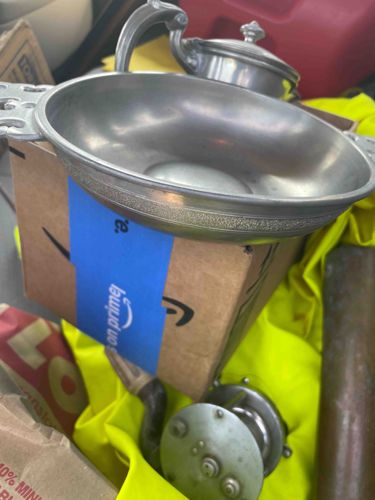
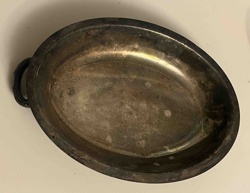
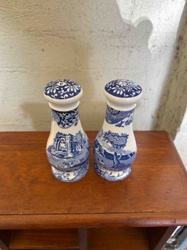
This item is a pewter porringer, a shallow bowl typically used for holding stew, soup, or porridge, often equipped with one or two handles. It is predominantly silver-gray in color, characteristic of aged pewter, suggesting a significant lead content or simply tarnishing over time. The bowl features a rounded, shallow basin. A prominent decorative band with a repeating, possibly geometric or floral, embossed pattern encircles the rim just below the lip, indicating a degree of craftsmanship beyond mere utilitarianism. One handle is clearly visible, extending horizontally from the rim, featuring an ornate, possibly pierced or stylized design, which adds to its aesthetic appeal. The surface exhibits a soft, somewhat dull luster, consistent with a patinated finish common to older pewter pieces, rather than a highly polished modern look. There are no obvious signs of significant damage like dents, cracks, or repairs visible in the provided image. The overall construction appears solid and well-made, typical of cast or spun pewter. While no specific maker's marks or signatures are discernible, the style of the handle and the decorative banding suggest it could be a piece from the 18th or 19th century, or a reproduction from a later period mimicking these styles. The visible patina is a natural aging process for pewter, which often enhances its antique appeal.
AI Appraisal Report
I have examined the image provided of this pewter porringer. The item presents as a classic example of a pewter porringer, characterized by its silver-gray coloration, shallow basin, and a single ornate handle. The visible decorative band encircling the rim is a strong indicator of craftsmanship beyond basic utility, suggesting a potential antique origin. The soft, dull luster and visible patination are consistent with aged pewter, enhancing its antique aesthetic. I note the absence of overt damage such as dents or cracks, which is positive for its condition.
From the image alone, however, I cannot definitively ascertain authenticity. The style of the handle and decorative banding broadly align with 18th or 19th-century pieces, or well-executed reproductions from a later period. The exact lead content, which could influence age and value, is also undeterminable without physical testing. For a full authentication, I would require a direct physical examination to inspect for maker’s marks or hallmarks, assess the weight and feel, and potentially perform scientific analysis of the metal composition. Provenance documentation, such as historical sales records or family histories, would also significantly aid in confirming its age and origin.
Based on current market conditions for antique pewter porringers, demand exists for well-preserved, authentic pieces. However, without confirmed authenticity and a specific maker or origin, the value is tempered. If it were definitively authenticated as an 18th-century American or European piece, its value would be significantly higher. For comparables, similar unsigned or unauthenticated pewter porringers in good visual condition typically fall within a certain range.
Therefore, considering its good visual condition and apparent age characteristics, but acknowledging the critical limitations of image-only appraisal regarding authenticity, I estimate an initial value. If it were found to be a genuine 18th or early 19th-century piece by a notable maker, the value could be considerably higher.