AI estimate as of August 1, 2025 · verify with a professional before acting
AI-Generated · Verify before acting
Everything on this page is generated by AI for informational purposes only. AI can make mistakes — the AI may misidentify items or misattribute them (artist, maker, brand, designer, origin, era). This is not an official valuation and should not be used for insurance, sale, tax, estate, legal, or lending purposes — or any decision requiring a certified appraisal. It is not an authoritative claim about any person, brand, or rights holder — do not share or rely on it as a factual statement about a third party. Always consult qualified professionals before making financial decisions.
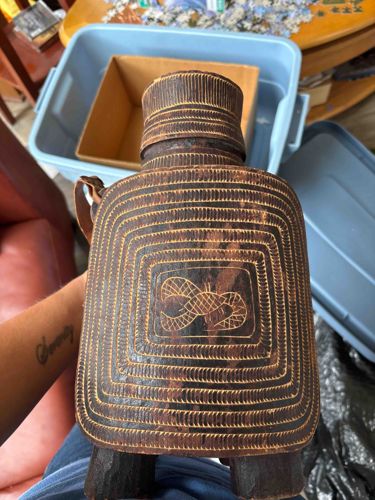
This appears to be a hand-carved wooden flask or canteen, likely of African or Indigenous origin, given the stylistic carvings and the overall rustic appearance. The flask is substantially sized, suggesting it was designed for practical use or as a significant decorative piece. It features a rectangular, flattened body with rounded edges, typical of many traditional canteens. The wood is dark brown, indicating either a naturally dark timber, staining, or a rich patina from age and use. The entire body is adorned with intricate incised patterns: concentric squares or rectangles form the primary design, each line punctuated by small, parallel carvings, creating a textured, almost basket-weave effect. At the center of the main face, there is a distinct rectangular cartouche containing a stylized, perhaps serpentine or knot-like, symbol. This symbol is carved with finer lines, contrasting with the broader repetitive patterns. The top of the flask incorporates a screw-on stopper or lid, which also appears to be carved from wood and features similar incised lines around its circumference, enhancing its integrated look. A small loop, possibly for a carrying strap, is visible on the side near the neck, suggesting its portability. The base of the flask has two stumpy, carved feet, elevating it slightly. The condition shows a desirable aged patina, with some visible wear consistent with wooden artifacts of this type and age. There are no obvious signs of major damage like cracks or repairs, which speaks to its robust craftsmanship. The carving quality is consistent and intricate, highlighting skilled handiwork rather than mass production. The item exudes an indigenous or tribal aesthetic, possibly dating from the mid-20th century or earlier.
AI Appraisal Report
Upon visual examination of this hand-carved wooden flask or canteen, I assess its overall condition as very good, consistent with an authentic artifact of significant age. The rich, dark brown patina and visible wear are desirable, indicating genuine age and use rather than artificial distressing. The intricate incised patterns, particularly the textured basket-weave effect and the distinct central cartouche with its stylized symbol, demonstrate skilled craftsmanship. The presence of a carved screw-on stopper and two stumpy feet adds to its unique character.
Authenticity, based solely on visual inspection of images, appears high. The carving style and rustic aesthetic strongly suggest an African or Indigenous origin, likely mid-20th century or earlier. There are no signs of modern tooling or mass production. No visible cracks or major repairs are apparent, which is excellent. However, a definitive determination of material type, specific origin, and exact age would require in-person examination. Scientific testing, such as wood analysis or radiocarbon dating, would be crucial for precise authentication and dating. Provenance documentation, detailing the object's history of ownership, would also significantly enhance its value and confirm authenticity.
From a market perspective, comparable items of ethnographic art, particularly functional yet decorative pieces, continue to see steady demand. The intricate carving, good condition, and apparent age contribute positively to its desirability. Rarity is moderate; while wooden flasks exist, this specific level of detailed carving combined with its condition makes it distinct. The main factors impacting value are its artistic merit, condition, and the lack of physical examination or provenance. Without these, it would be difficult to attribute it to a specific tribe or carver, which commands higher prices. Overall, it is a compelling piece of ethno-graphic art.