Edwardian-Style Gilt-Edged Porcelain Fruit Plate
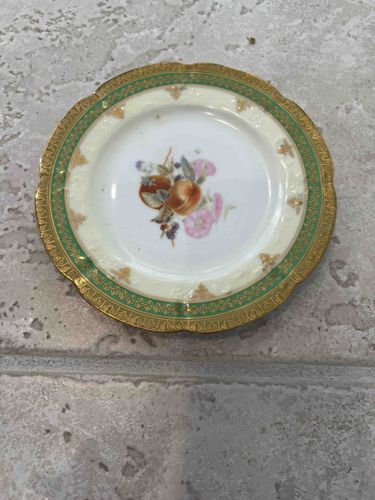
This is a decorative porcelain cabinet plate, likely dating from the early to mid-20th century. The piece features a central hand-colored or lithographic transfer motif depicting a medley of fruit and flowers, including a peach, grapes, and morning glory blooms. The construction consists of a fine white porcelain body with a scalloped edge and a multi-tiered decorative rim. The outer border is finished in a heavy gold-gilt filigree pattern over a rich forest green ground, followed by an inner cream-colored band accented with raised gold fleur-de-lis or acanthus leaf motifs. The overall craftsmanship suggests a high-quality manufacturer, possibly of English, Bavarian, or French origin, though no visible maker's mark is shown on the top surface. The condition appears fair to good; there is visible wear to the central fruit transfer and light surface scratches consistent with age and use. The gold gilding on the outer rim shows typical minor rubbing and patina. There are no obvious large cracks or chips visible from this angle, though the surface exhibits some minor kiln dust spots or imperfections in the glaze, which are common in historical ceramics.
AI-Generated Appraisal Disclaimer
Estimated Value
$65 - $110
Basic Information
Category
Fine Ceramics and Porcelain
Appraised On
January 23, 2026
Estimated Value
$65 - $110
Item Description
This is a decorative porcelain cabinet plate, likely dating from the early to mid-20th century. The piece features a central hand-colored or lithographic transfer motif depicting a medley of fruit and flowers, including a peach, grapes, and morning glory blooms. The construction consists of a fine white porcelain body with a scalloped edge and a multi-tiered decorative rim. The outer border is finished in a heavy gold-gilt filigree pattern over a rich forest green ground, followed by an inner cream-colored band accented with raised gold fleur-de-lis or acanthus leaf motifs. The overall craftsmanship suggests a high-quality manufacturer, possibly of English, Bavarian, or French origin, though no visible maker's mark is shown on the top surface. The condition appears fair to good; there is visible wear to the central fruit transfer and light surface scratches consistent with age and use. The gold gilding on the outer rim shows typical minor rubbing and patina. There are no obvious large cracks or chips visible from this angle, though the surface exhibits some minor kiln dust spots or imperfections in the glaze, which are common in historical ceramics.
Get Your Items Appraised
Instant estimates of your treasures with AI-powered instant appraisals