Japanese Arita-style Blue and White Porcelain Saucer with Calligraphic Mark
Antique/Vintage Ceramics and Porcelain

Japanese Arita-style Blue and White Porcelain Saucer with Calligraphic Mark

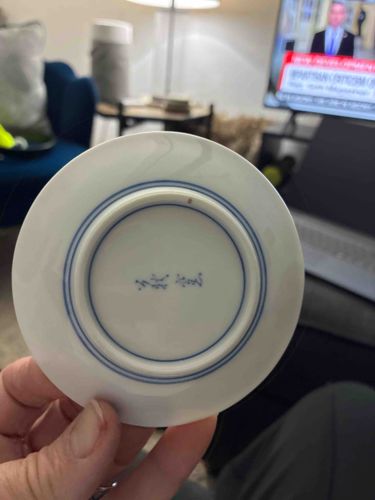
This is a small, circular porcelain saucer or tea plate, likely of Japanese origin, specifically from the Arita or Imari regions. The item is constructed from high-quality white kaolin clay, resulting in a bright, vitreous body and a smooth, reflective glaze. The underside features a prominent unglazed foot rim, which reveals the fine-grained white paste typical of 20th-century porcelain production. Within the foot rim are two concentric underglaze blue circles enclosing a four-character calligraphic mark. The mark is executed in a cursory, handwriting style, which may indicate a potter's name or a kiln mark from a mid-to-late 20th-century workshop. In terms of condition, the piece appears to be in excellent structural shape with no visible chips, cracks, or restorations. A single small brown ferrous 'kiln spot' is visible on the foot rim, occurring naturally during the firing process when iron particles in the clay oxidize. The glaze is even and shows no signs of significant scuffing or utensil wear, suggesting it has been well-maintained. The simple blue and white aesthetic is a hallmark of traditional Japanese ceramic styles intended for tea ceremonies or daily domestic use.
Estimated Value

$45.00 - $75.00

Basic Information

Category

Antique/Vintage Ceramics and Porcelain

Appraised On

March 27, 2026

Estimated Value

$45.00 - $75.00

Item Description

This is a small, circular porcelain saucer or tea plate, likely of Japanese origin, specifically from the Arita or Imari regions. The item is constructed from high-quality white kaolin clay, resulting in a bright, vitreous body and a smooth, reflective glaze. The underside features a prominent unglazed foot rim, which reveals the fine-grained white paste typical of 20th-century porcelain production. Within the foot rim are two concentric underglaze blue circles enclosing a four-character calligraphic mark. The mark is executed in a cursory, handwriting style, which may indicate a potter's name or a kiln mark from a mid-to-late 20th-century workshop. In terms of condition, the piece appears to be in excellent structural shape with no visible chips, cracks, or restorations. A single small brown ferrous 'kiln spot' is visible on the foot rim, occurring naturally during the firing process when iron particles in the clay oxidize. The glaze is even and shows no signs of significant scuffing or utensil wear, suggesting it has been well-maintained. The simple blue and white aesthetic is a hallmark of traditional Japanese ceramic styles intended for tea ceremonies or daily domestic use.
Get Your Items Appraised

Instant estimates of your treasures with AI-powered instant appraisals

Browse More Appraisals