AI Appraisal Estimate

AI-generated estimates · not official valuations

From the user

What was submitted

Photo and notes provided by the user — not generated by AI

Submitted item photo
Submitted photo · June 20, 2026

User's notes

No additional notes provided.

AI analysis below

AI appraisal

AI analysis & estimate

AI-Generated · Verify before acting

Everything below is generated by AI for informational purposes only. AI can make mistakes — the AI may misidentify items or misattribute them (artist, maker, brand, designer, origin, era). This is not an official valuation and should not be used for insurance, sale, tax, estate, legal, or lending purposes — or any decision requiring a certified appraisal. It is not an authoritative claim about any person, brand, or rights holder — do not share or rely on it as a factual statement about a third party. Always consult qualified professionals before making financial decisions.

Read the full disclaimer

AI Identification

·Not independently authenticated·Verify before acting

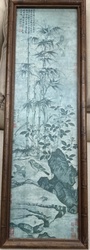
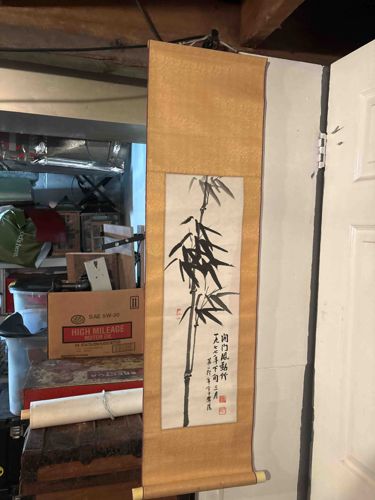
Chinese Ink Wash Hanging Scroll of Bamboo

Asian Fine Art / Calligraphy and Paintings

AI Estimated Value

·Not an official valuation·Verify before acting

$350 - $600

As of June 20, 2026

AI Item Analysis

·AI can make mistakes·Verify before acting
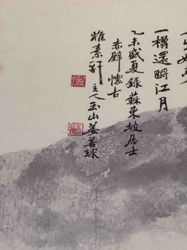
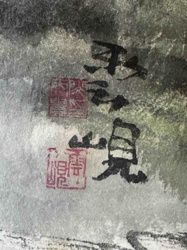
This is a vertical hanging scroll (kakemono) featuring a traditional ink wash painting (sumi-e style) depicting a bamboo shoot. The central artwork is rendered in black ink on a light-colored paper or silk substrate, mounted onto a decorative light-gold or mustard-toned silk brocade mounting with a subtle woven floral pattern. The bamboo is executed with confident, varying brushstrokes, showcasing 'life-movement' (qiyun) through the contrast of dark, saturated leaves and lighter, jointed stalks. To the right of the bamboo is a vertical column of Chinese calligraphy accompanied by two distinct red cinnabar artist seals, likely denoting the artist's name and perhaps a studio or poetic name. The scroll is suspended via a top wooden rod and weighted by a bottom roller with light-colored (possibly plastic or bone) end knobs. Historically, such works often date from the mid-to-late 20th century, though they emulate classical Ming or Qing dynasty aesthetics. The condition appears fair to good; there are noticeable horizontal 'crackle' lines or creases across the paper surface, common with age and repeated rolling/unrolling. The mounting edges show minor fraying, and there is slight discoloration characteristic of light exposure and storage in a non-climate-controlled environment. The craftsmanship suggests a skilled hand-painted piece rather than a mass-market print, given the bleed and gradient visible in the ink work.
AI Appraisal Report

·AI can make mistakes·Verify before acting
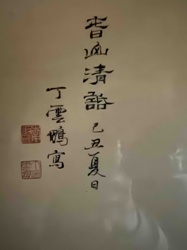
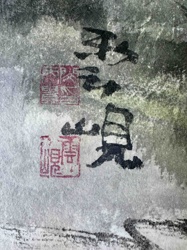
I have examined the digital representation of this vertical hanging scroll depicting bamboo. The piece exhibits traditional literati aesthetic, utilizing 'xieyi' (spontaneous) brushwork. The ink tonality suggests hand-ground soot ink rather than synthetic pigments, and the 'bone' method in the stalks indicates a practiced hand. However, the pervasive horizontal creasing across the paper substrate is a significant condition issue; these 'breaks' result from the hardening of the mounting paste over time and repeated rolling. Such damage typically requires professional remounting to prevent further loss of the pigment layer. Regarding authenticity, while the seals and calligraphy appear consistent with mid-20th-century artistic production intended for the scholar-class or collectors, they do not immediately correspond to known high-auction masters of the period. The market for generic post-war Chinese ink paintings remains stable but is highly price-sensitive to condition and provenance. Comparables for unsigned or minor-artist bamboo scrolls in similar condition typically realize $300 to $700 at regional auction houses. Critically, authentication via imagery has sharp limitations. To confirm if this is a Republic-era work or a later 20th-century homage, I would need to inspect the paper's fiber under UV light to check for modern bleaching agents and handle the silk mounting to determine if it is true silk or a synthetic blend. A definitive valuation would also require translating the specific seals and inscription to rule out any association with a recognized school. Currently, the value resides in its decorative appeal and traditional execution rather than verified historical rarity.

Get your items appraised

Instant estimates of your treasures with AI-powered appraisals

Browse More Appraisals