AI Appraisal Estimate

AI-generated estimates · not official valuations

From the user

What was submitted

Photo and notes provided by the user — not generated by AI

Submitted item photo
Submitted photo · July 1, 2026

User's notes

No additional notes provided.

AI analysis below

AI appraisal

AI analysis & estimate

AI-Generated · Verify before acting

Everything below is generated by AI for informational purposes only. AI can make mistakes — the AI may misidentify items or misattribute them (artist, maker, brand, designer, origin, era). This is not an official valuation and should not be used for insurance, sale, tax, estate, legal, or lending purposes — or any decision requiring a certified appraisal. It is not an authoritative claim about any person, brand, or rights holder — do not share or rely on it as a factual statement about a third party. Always consult qualified professionals before making financial decisions.

Read the full disclaimer

AI Identification

·Not independently authenticated·Verify before acting

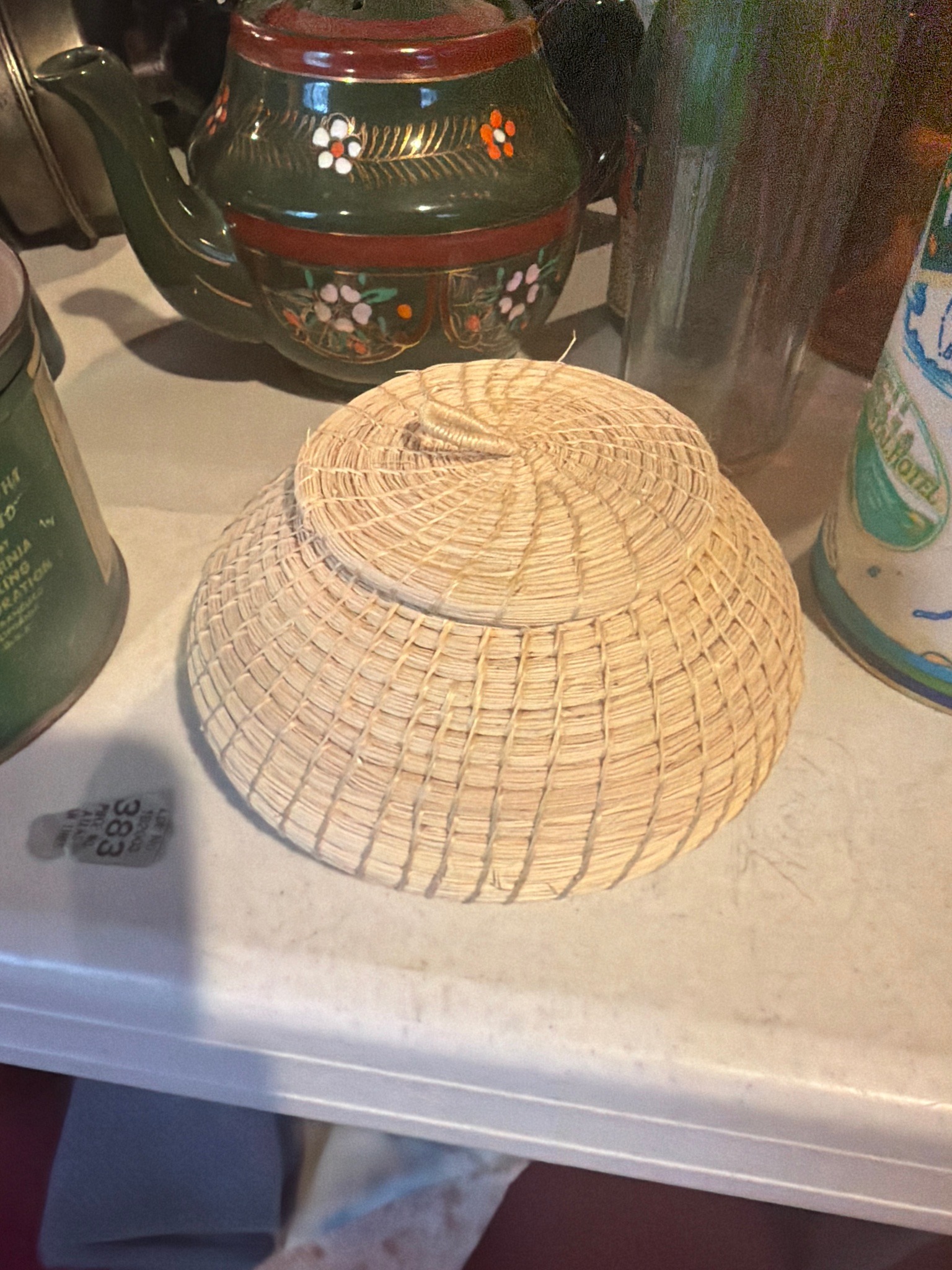
Hand-Woven Lidded Coiled Basket

Decorative Arts / Folk Art

AI Estimated Value

·Not an official valuation·Verify before acting

$45 - $85

As of July 1, 2026

AI Item Analysis

·AI can make mistakes·Verify before acting
This item is a small, dome-shaped woven basket with a separate, slightly recessed lid. The basket is constructed using a traditional coiling technique, likely utilizing raffia, straw, or similar natural plant fibers. In this specific construction, bundles of fiber are coiled and secured with thinner vertical stitches, creating a textured, grid-like pattern across the globular body. The natural color is a pale, uniform tan or light straw hue. The lid is characterized by a central spiral start that extends outward to the rim, finished with a small, looped fiber handle or pull at the very center for ease of opening. Physically, the basket appears to be roughly 4 to 6 inches in diameter. The craftsmanship is highly consistent, demonstrating skilled hand-weaving with uniform tension throughout the stitches. Regarding condition, the fibers appear dry but structurally sound; there are some minor loose fiber ends or 'flyaways' visible on the lid's pull and along the rim, which is typical for aged natural vegetable fibers. There are no obvious stains, significant breaks in the coils, or heavy bleaching from sun exposure. This style of utilitarian yet decorative basketry is common in many global folk traditions, particularly those from African or Indigenous American cultures, and likely dates from the mid-to-late 20th century.
AI Appraisal Report

·AI can make mistakes·Verify before acting
Based on my visual examination of this lidded coiled basket, I have assessed it as a mid-20th-century piece of ethnographic folk art. The construction demonstrates a high degree of technical skill, utilizing a consistent bundles-and-stitch coiling method typical of many pastoralist styles, such as those found in Southern or Eastern Africa (e.g., Zulu or Tswana) or North American Indigenous traditions. The uniform tension and central spiral on the lid indicate a practiced hand. The condition appears very good for a natural fiber object; the minor 'flyaways' at the pull and rim are consistent with the desiccation of organic materials over time and do not represent significant structural degradation. The monochromatic, natural palette suggests it was intended for utilitarian use or early tourist trade rather than high-concept gallery display. The market for such items is currently stable but saturated with similar vintage examples. Values for unidentified coiled baskets of this scale generally remain in the $45 to $85 range, as they lack any specific diagnostic signatures or rare pigmentation. My valuation is limited by the digital nature of this inspection. I cannot definitively verify the specific plant species without microscopic analysis or assess internal structural integrity (such as hidden pests or brittle inner coils). A full authentication would require provenance documentation tracing the item to a specific maker or region and an in-person tactile assessment to confirm the weight and flexibility of the fibers, which helps distinguish between authentic period pieces and modern mass-produced replicas.

Get your items appraised

Instant estimates of your treasures with AI-powered appraisals

Browse More Appraisals