AI estimate as of September 28, 2025 · verify with a professional before acting
AI-Generated · Verify before acting
Everything on this page is generated by AI for informational purposes only. AI can make mistakes — the AI may misidentify items or misattribute them (artist, maker, brand, designer, origin, era). This is not an official valuation and should not be used for insurance, sale, tax, estate, legal, or lending purposes — or any decision requiring a certified appraisal. It is not an authoritative claim about any person, brand, or rights holder — do not share or rely on it as a factual statement about a third party. Always consult qualified professionals before making financial decisions.
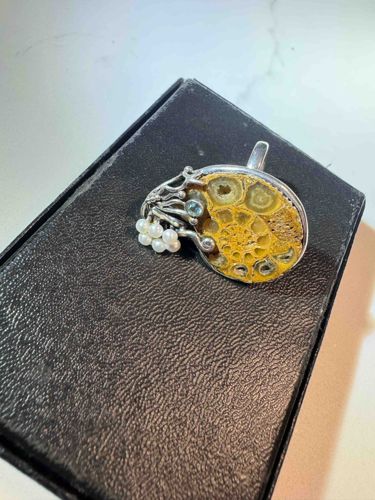
This is an intricately designed pendant featuring a polished section of an ammonite fossil, set within a sterling silver frame. The ammonite displays striking internal chamber structures, visible as irregular, undulating patterns of amber-yellow and light brown hues, some with glistening crystalline formations within the voids, suggesting a druzy or geode-like quality. The overall shape of the fossil piece is oval or rounded, approximately 1 to 1.5 inches in its longest dimension, and it is framed by a highly polished, possibly oxidized, sterling silver bezel. Adorning one side of the silver frame is a stylized organic embellishment, perhaps representing seaweed or natural tendrils, from which descend a cluster of small, round, white to off-white freshwater pearls, likely numbering around five to seven, each approximately 2-3mm in diameter. Integrated into the silverwork are also two small, round, faceted gemstones, possibly blue topaz or aquamarine, adding a subtle touch of color. The silver appears to be hand-wrought, exhibiting some textural variations and a handcrafted aesthetic, particularly in the tendril elements. A sturdy silver bail is attached at the top for suspension on a chain. The visible condition appears excellent, with no obvious signs of damage, chips, or significant wear to the fossil or pearls, and the silver maintains a good luster. The craftsmanship suggests a contemporary artisanal piece, likely from the late 20th or early 21st century, combining natural elements with artistic metalwork. The unique characteristics of the fossil and the thoughtful inclusion of pearls and accent stones contribute to its distinctiveness.
AI Appraisal Report
Upon visual examination of the provided image, I assess this Fossil Ammonite and Pearl Pendant in Sterling Silver to be in excellent condition. The fossil section itself, with its striking internal chamber structures and crystalline formations, appears well-preserved with no visible chips or damage. The sterling silver setting exhibits good luster, and the handcrafted elements, particularly the organic tendrils and bezel work, show competent artisanal skill. The freshwater pearls appear intact, and the accent gemstones (likely blue topaz or aquamarine) add a subtle, appealing touch.
Authenticity of the fossil as a genuine ammonite is highly probable given the distinct internal structures visible. However, specific geological origin or species identification would require direct physical examination. The sterling silver and pearls also appear authentic based on the image, though verifying metal purity or pearl origin with absolute certainty would necessitate in-person inspection and potential testing. The craftsmanship strongly suggests a contemporary artisanal piece, likely late 20th or early 21st century.
The market for unique, artisan-crafted jewelry featuring natural elements is stable. Comparable pieces often fetch values influenced by the quality and rarity of the fossil, the intricacy of the silverwork, and the inclusion of additional gemstones. The fossil's druzy-like quality enhances its appeal. Demand for such distinctive, nature-inspired jewelry remains consistent. Factors significantly impacting value here are the unique fossil specimen and the handcrafted sterling silver. Limitations in full authenticity verification stem from the image-only examination; an in-person inspection would allow for detailed observation of inclusions, weight, and precise measurements, which could influence the final assessment. Furthermore, any provenance documentation from the artist or original purchase would add significant value.