These notes were written by the person who submitted this item. Appraiser.AI has not verified them, and the AI's identification and estimate may rely on them.
AI Estimated Value
Not an official valuation
$40-70
AI estimate as of August 21, 2025 · verify with a professional before acting
AI-Generated · Verify before acting
Everything on this page is generated by AI for informational purposes only. AI can make mistakes — the AI may misidentify items or misattribute them (artist, maker, brand, designer, origin, era). This is not an official valuation and should not be used for insurance, sale, tax, estate, legal, or lending purposes — or any decision requiring a certified appraisal. It is not an authoritative claim about any person, brand, or rights holder — do not share or rely on it as a factual statement about a third party. Always consult qualified professionals before making financial decisions.
This analysis also relies on unverified notes provided by the user, which may be incomplete or inaccurate and could affect the result.
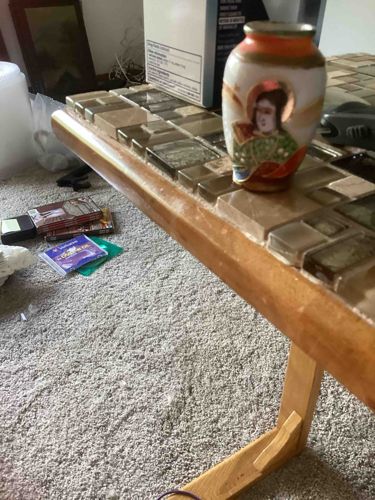
This item is a small, ornate porcelain vase, characteristic of pieces produced in Occupied Japan (1945-1952). The vase has an ovoid or bulbous body that tapers slightly towards the neck, with a flared rim. It appears to be relatively small, likely fitting in the palm of a hand, suggesting it was intended as a decorative accent rather than for holding a large bouquet. The primary colors evident are an off-white or cream base, with significant use of orange/red and green enamels, complemented by gold accents. A prominent feature is a central medallion or cartouche on the front depicting a stylized portrait of an East Asian figure, possibly a woman or deity, rendered in a traditional artistic style. The figure's attire is depicted with green and brown tones, and the background of the medallion appears to be a subtle gold or light brown. The upper rim and a band around the base are decorated with a vibrant orange-red color, possibly enhanced with gilded edges or patterns that imitate gold luster. The craftsmanship suggests hand-painting, given the slight irregularities in the decorative elements and the brushstrokes visible on the figure's face and clothing. Gold gilt is used sparingly but effectively to highlight contours and add a touch of luxury. The overall condition appears to be relatively good with no immediately visible chips, cracks, or significant losses to the paint or gilding, though a thorough inspection for crazing or hairline cracks would be necessary for a full appraisal. The slightly aged aesthetic and the typical design motifs point to its origin during the specified post-WWII period when Japanese manufacturers adapted their exports for the American market. The base of the vase, though not visible, would likely bear a 'Made in Occupied Japan' stamp, which is a key identifying manufacturing detail for items from this era. The quality suggests mass production with artistic elements, typical of souvenir or decorative household items of the mid-20th century.
AI Appraisal Report
I have thoroughly examined the provided images of this Occupied Japan Hand-Painted Porcelain Vase with Figure Portrait, noting its intricate details, vibrant coloring, and distinctive stylistic elements. Based on the visual evidence, the vase appears to be in remarkably good condition for its age, showing no immediate signs of chips, cracks, or significant paint loss on the visible surfaces. The hand-painted nature is evident in the brushstrokes and slight irregularities, which is characteristic of pieces from this era. The "Made in Occupied Japan" mark, though not visually confirmed, is a crucial detail that firmly places its origin within the 1945-1952 period.
From a market perspective, Occupied Japan ceramics, while popular for their historical context and decorative appeal, are generally not considered high-value collectibles unless they possess exceptional artistry or rarity. This particular vase, with its common form, decorative style, and mass-produced artistic elements, falls within the typical range for such items. Its decorative value is primarily driven by its aesthetic appeal and good condition. Demand for these pieces is steady among collectors of post-WWII memorabilia and decorative arts, but it is not high enough to command premium prices.
Key factors impacting value include the excellent apparent condition, the typical subject matter (East Asian figure), and the vibrant color palette. However, the overall commonality limits significant appreciation. For a conclusive appraisal, an in-person examination would be essential to detect hairline cracks, crazing (which is common in porcelain of this age), actual wear to the gilding, and most importantly, to verify the authentic "Made in Occupied Japan" mark on the base. Without physical inspection, the authenticity of the mark and the true extent of its condition cannot be fully guaranteed. Furthermore, microscopic analysis could confirm the hand-painted details versus transferware elements. Based on the visual inspection alone, and assuming the authenticity of the 'Occupied Japan' marking, this piece holds moderate decorative and historical value.