AI estimate as of November 17, 2025 · verify with a professional before acting
AI-Generated · Verify before acting
Everything on this page is generated by AI for informational purposes only. AI can make mistakes — the AI may misidentify items or misattribute them (artist, maker, brand, designer, origin, era). This is not an official valuation and should not be used for insurance, sale, tax, estate, legal, or lending purposes — or any decision requiring a certified appraisal. It is not an authoritative claim about any person, brand, or rights holder — do not share or rely on it as a factual statement about a third party. Always consult qualified professionals before making financial decisions.
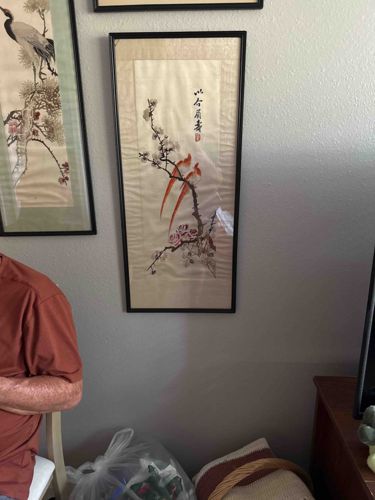
This item is a framed Asian silk painting, likely a hang scroll or similar artwork mounted for display. The artwork itself depicts two red-hued birds perched amidst blooming plum blossoms and branches. The birds, distinguished by their vibrant orange-red bodies and slender forms, are intertwined with the intricate brown branches, suggesting a harmonious natural scene. The plum blossoms are rendered in delicate shades of pink and white, with subtle detailing visible in their petals. The background appears to be a light cream or ivory-colored silk, which shows some subtle horizontal textural lines, possibly from the weaving of the silk or the mounting process.
In the upper right portion of the painting, there are Asian characters, likely an artist's signature, poem, or dedication, rendered in dark ink. Below these characters, a red chop mark or seal is visible, indicating a traditional Asian artistic practice for authentication or signature. The painting is housed under glass within a simple, narrow black wooden frame, which provides a clean border for the artwork without distracting from its details. The frame appears to be in good condition with no immediately visible damage. While specific age is difficult to determine without close examination of the materials and a clearer view of the signature, the style suggests it could be 20th century or earlier, reflecting traditional Chinese or Japanese artistic styles. The overall condition of the painting within the frame appears to be very good with no visible tears, significant discoloration, or moisture damage. The craftsmanship of the painting, particularly the delicate brushwork for the blossoms and birds, indicates a level of artistic skill.
AI Appraisal Report
Based on my visual examination of the provided image, this framed Asian silk painting depicting birds and plum blossoms appears to be in very good condition. The artwork itself shows no visible tears, significant discoloration, or moisture damage. The delicate brushwork for the birds and blossoms suggests a competent level of artistic skill. The simple black wooden frame also appears well-maintained.
Authenticity, however, is a primary limitation when relying solely on images. The Asian characters and red chop mark in the upper right are crucial for identification, potentially indicating an artist, poem, or dedication. Without a clear, decipherable image of these elements, and without the ability to physically inspect the silk, pigment, and mounting techniques, a definitive attribution of artist, origin (Chinese or Japanese), or precise age is not possible. In-person examination would allow for closer inspection of the silk's weave, pigment composition, and the precise execution of the brushwork and seals, which are vital for authenticating the piece. Provenance documentation, such as purchase receipts or exhibition history, would also significantly enhance authenticity.
Considering the apparent quality of the artwork and its good condition, but without definitive authentication of artist or precise age, current market conditions for decorative Asian art of this nature suggest a value in the range of $250-400. Demand for well-executed decorative Asian silk paintings remains steady, but rarity is difficult to assess without further authentication. If the signature and seal could be unequivocally attributed to a known or listed artist, the value could be considerably higher. Conversely, if it is a mass-produced decorative piece, the value would be lower.