AI Appraisal Estimate

AI-generated estimates · not official valuations

From the user

What was submitted

Photo and notes provided by the user — not generated by AI

Submitted item photo
Submitted photo · June 22, 2026

User's notes

Antique Wedgwood gurgle pitcher

AI analysis below

AI appraisal

AI analysis & estimate

AI-Generated · Verify before acting

Everything below is generated by AI for informational purposes only. AI can make mistakes — the AI may misidentify items or misattribute them (artist, maker, brand, designer, origin, era). This is not an official valuation and should not be used for insurance, sale, tax, estate, legal, or lending purposes — or any decision requiring a certified appraisal. It is not an authoritative claim about any person, brand, or rights holder — do not share or rely on it as a factual statement about a third party. Always consult qualified professionals before making financial decisions.

Note

This analysis also relies on unverified notes provided by the user, which may be incomplete or inaccurate and could affect the result.

Read the full disclaimer

AI Identification

·Not independently authenticated·Verify before acting

Antique Wedgwood Glazed Majolica Gluggle Jug / Gurgle Pitcher

Antique Ceramics / British Pottery

AI Estimated Value

·Not an official valuation·Verify before acting

$450 - $650

As of June 22, 2026

AI Item Analysis

·AI can make mistakes·Verify before acting
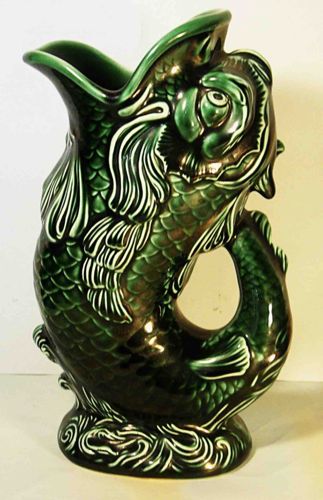
This is a decorative ceramic pitcher, commonly known as a 'gluggle jug' or 'gurgle pitcher,' likely produced by Wedgwood in the late 19th to early 20th century. The vessel is meticulously sculpted in the form of a leaping fish, traditionally modeled after a sea bass or cod. It features a rich, deep emerald green majolica-style lead glaze with darker forest-green or blackish pooling in the recessed areas, which serves to emphasize the highly detailed relief work. The design includes textured scales across the body, flowing fins that double as the handle, and a large open mouth that serves as the pouring spout. The base is ornately decorated with swirling wave motifs, providing structural stability and thematic consistency. The glazing exhibits a high-gloss vitrified finish that appears well-preserved, though typical for its age, one might expect fine micro-crazing upon close inspection. There are no immediate visible signs of major structural chips, cracks, or professional restorations in this view. The interior is likely also glazed in green or a contrasting white. These pitchers are celebrated for the unique gurgling sound they produce when liquid is poured, caused by air trapped in the tail section. This specific forest-green coloration and the sharpness of the mold indicate a high-quality production run characteristic of Victorian-era English ceramics.
AI Appraisal Report

·AI can make mistakes·Verify before acting
I have examined the digital representations of this antique Gluggle Jug, which appears to be a fine example of late 19th-century British Majolica. The vessel exhibits the 'high-relief' modeling and deep, saturated green lead glaze characteristic of Wedgwood’s Victorian output. The mold sharpness is particularly high, suggesting an early run before the molds became blurred from overuse. Condition appears excellent with no visible losses to the characteristically fragile fins or tail section, though I suspect fine age-crazing is present under the vitrified surface, which is standard for this period. Current market demand for Victorian figurals remains steady, particularly for iconic forms like the leaping fish in deep green, which commands a premium over common 20th-century reproductions by Dartmouth or Wade. Comparables for genuine Wedgwood Majolica pieces of this scale range from $400 to $700 depending on the presence of impressed markings. Limitations: This appraisal is based on photographic evidence only. Visual inspection alone cannot definitively rule out professional airbrushed restorations or hairline cracks. For full authentication, I would require an in-person physical inspection of the base for the 'WEDGWOOD' impressed mark and date coding (e.g., a three-letter code indicating year of manufacture). A black-light test would also be necessary to confirm the absence of modern epoxy repairs to the tail and spout.

Get your items appraised

Instant estimates of your treasures with AI-powered appraisals

Browse More Appraisals